AI Communications









Learn how enterprises can use conversational AI to improve CX, efficiency, and employee experience.
Artificial intelligence (AI) already plays a behind-the-scenes role in how many businesses operate, from forecasting demand to automating workflows.
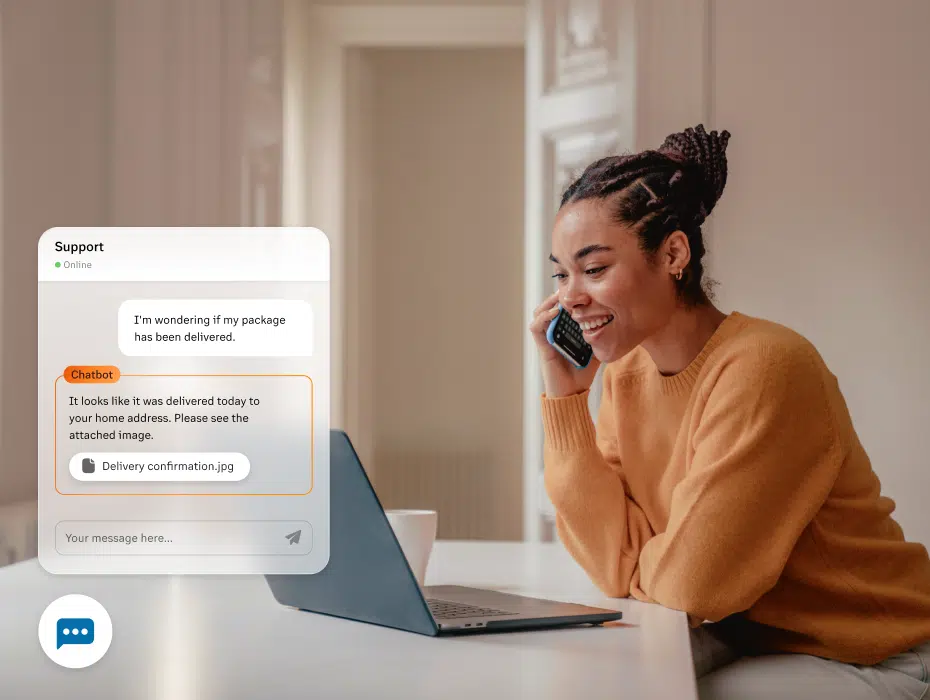
Conversational AI brings that intelligence to the front lines. It engages directly with customers and employees by answering questions, routing calls, assisting agents, and capturing insights across voice and digital channels.
But what exactly is conversational AI, and how does it drive measurable ROI for enterprise call centers? Here’s a practical breakdown of how it works and how it can benefit your business.
Key takeaways
- Conversational AI holds natural, end-to-end dialogue across voice and digital channels
- It runs on NLP, machine learning, speech recognition, and voice synthesis
- Enterprises apply it in customer service, contact centers, and internal help desks
- It lowers cost per interaction, lifts customer satisfaction (CSAT), and reduces agent burnout
- Plan for its limits: hallucination, bias, and explainability all need governance
What is conversational AI?
Conversational AI is technology that lets people interact with software through natural spoken or typed language instead of menus or forms. It combines natural language processing (NLP), machine learning (ML), and speech recognition to understand intent, hold context across a conversation, and respond in real time across voice and digital channels.

That matters for enterprises because it moves AI from a novelty chatbot to infrastructure that carries live customer and employee interactions at volume. In practice, conversational AI powers virtual receptionists, intelligent virtual agents in contact centers, chat-based AI assistants, and coaching tools for human agents.
Generative AI vs. conversational AI
Generative AI (gen AI) is the broad category of models that create new content (text, images, code, or audio) and includes popular tools like ChatGPT and Claude. Gen AI is useful for tasks like drafting emails, summarizing documents, and generating creative assets.
Conversational AI applies generative AI specifically to dialogue, enabling back-and-forth exchanges, turn-taking, and context-aware responses. It can understand intent, remember what was just said, and respond naturally. Voice assistants like Siri or Alexa and self-service bots that answer questions like, “Where’s my order?” are common examples.
Put simply, every modern conversational AI system uses generative AI, but not every generative AI application is built for live, two-way conversation flows.
Conversational AI vs. chatbots vs. conversational AI chatbots
Traditional chatbots are text-based interfaces that follow scripts or decision trees. They respond to predefined inputs but don’t truly understand language or context, meaning they don’t qualify as conversational AI.
Conversational AI is the broader capability that allows bots to understand natural language, exhibit contextual awareness, and respond flexibly.
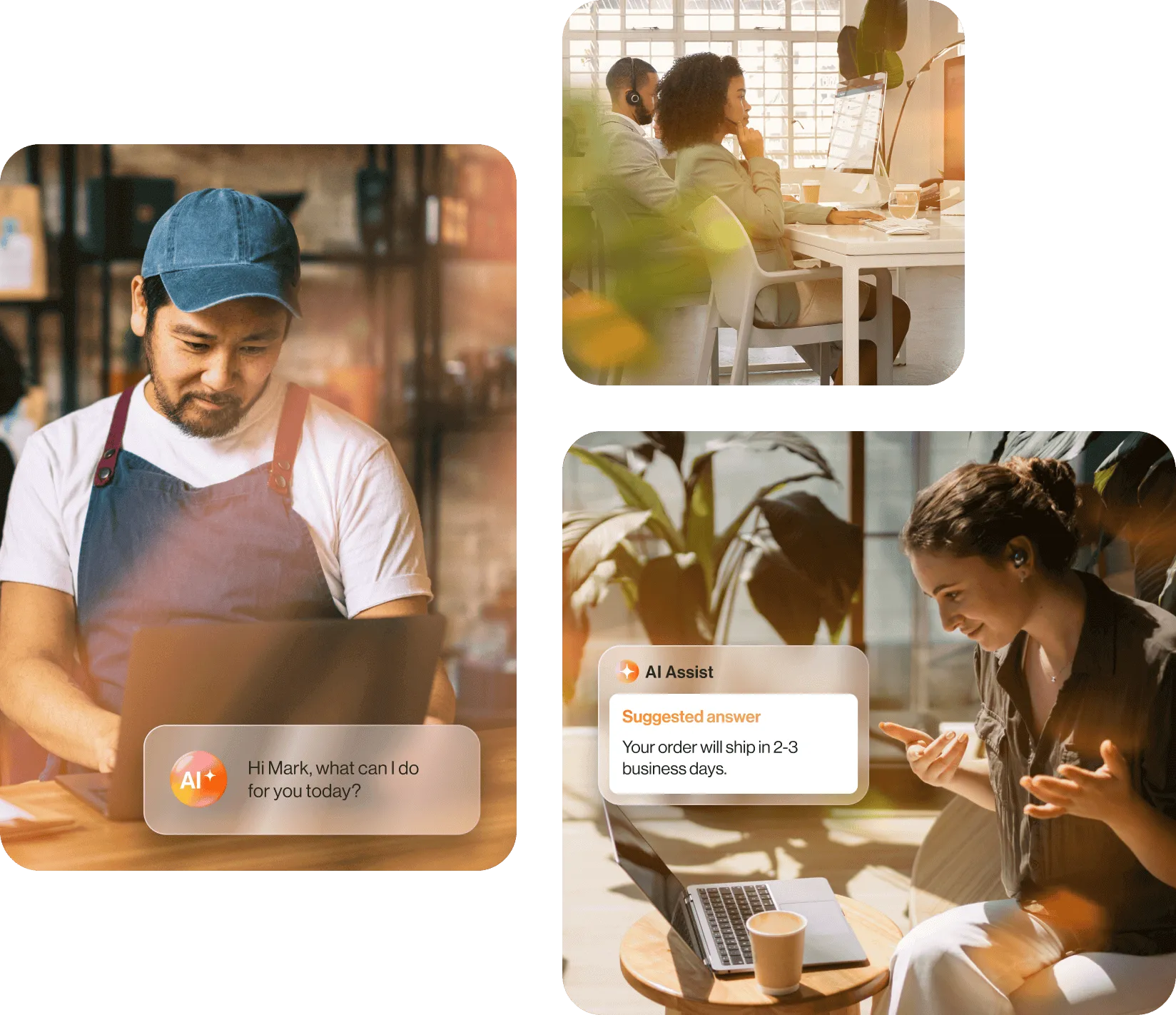
When you combine the two, you get conversational AI chatbots: systems that interpret free-form questions, maintain context across interactions, and deliver more natural, human-like responses. These bots, sometimes referred to as AI virtual agents, support far more complex customer journeys than legacy, button-based chatbots.
Conversational AI vs. conversation intelligence
Conversational AI and conversation intelligence are complementary, but they serve different purposes:
- Conversational AI participates in the interactions themselves. It answers calls, chats with customers, and assists agents in real time by focusing on what’s happening in the moment.
- Conversation intelligence analyzes interactions during or after they occur. It transcribes conversations, identifies topics and sentiment, flags compliance risks, and surfaces patterns that inform coaching, routing, and workflow improvements.
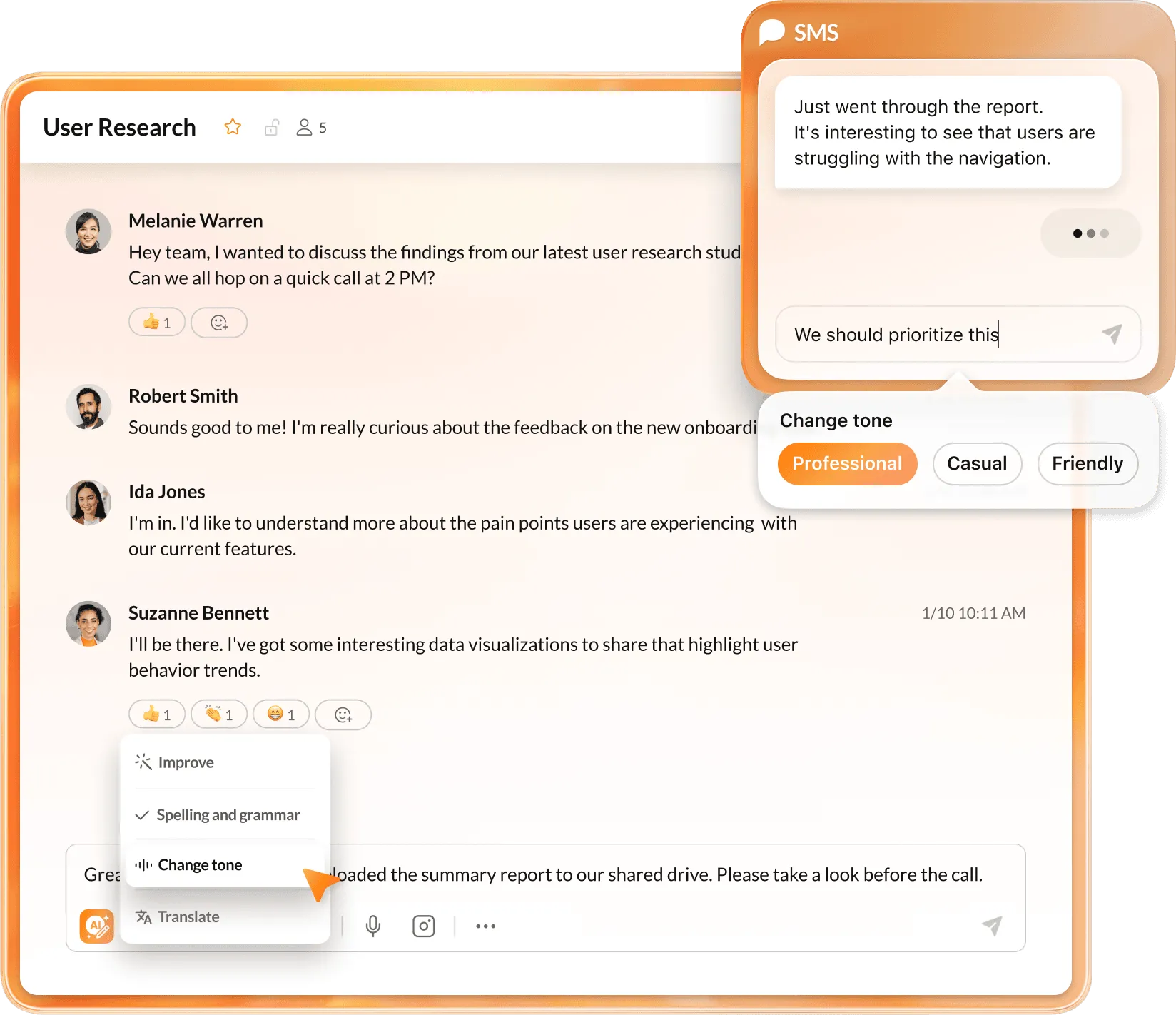
The two can work in tandem. For example, if conversation intelligence reveals a spike in password reset calls, a conversational AI solution can automate those requests going forward.
How conversational AI works
Under the interface, conversational AI runs on a stack of components that turn a spoken or typed request into an action. Understanding the mechanics helps you judge where a system will hold up and where it will break.
NLP is the overarching discipline for parsing human language, recognizing intent, and pulling out entities like dates, locations, and account numbers. Two subsets do the heavy lifting:
- Natural language understanding (NLU) interprets what someone means, even when two people phrase the same request in completely different ways.
- Natural language generation (NLG) handles output generation, crafting the response so it reads as clear and human rather than robotic or repetitive.
Around that language core sit four more layers:
- Machine learning improves intent recognition, response quality, and routing decisions as the system processes more interactions.
- Automatic speech recognition (ASR) converts speech to text in real time across accents and noisy environments.
- Voice synthesis, or text-to-speech (TTS), turns generated text back into natural speech with proper intonation and low latency.
- Integrations connect the system to your customer relationship management (CRM) platform, ticketing, billing, and knowledge bases so it can decide when to respond directly, trigger a workflow, or escalate to a human.
For voice-first use cases, seamless integration with telephony and network infrastructure is essential, as implementation directly affects reliability, call quality, latency, and the experience of both customers and agents.
8 enterprise use cases for conversational AI
In large organizations, conversational AI isn’t about deploying a single bot. It’s about redesigning your communications strategy: how conversations flow across your business when people ask questions, request changes, or need guidance.
The fastest impact shows up in high-volume, repeatable interactions, which split into two domains: customer-facing service and internal employee support.
Customer-facing conversational AI examples

By 2028, Gartner predicts that more than 70% of customers will begin service interactions via conversational AI. High interaction volumes, repeatable intents, and clear escalation paths make customer support ideal for automation and augmentation. As a result, customer service often delivers the clearest ROI from conversational AI.
Common use cases include:
- Replacing rigid IVR menus with natural language experiences. With AI-powered IVR, customers say what they need instead of navigating a phone tree. The system routes the interaction, answers the question, or triggers a workflow like a balance check or appointment change.
- Automating transactional self-service tasks. High-volume, well-defined tasks like order status, payment arrangements, appointment scheduling, and password resets are strong automation candidates. The customer service AI authenticates the user, retrieves data, confirms details, and completes the transaction end to end.
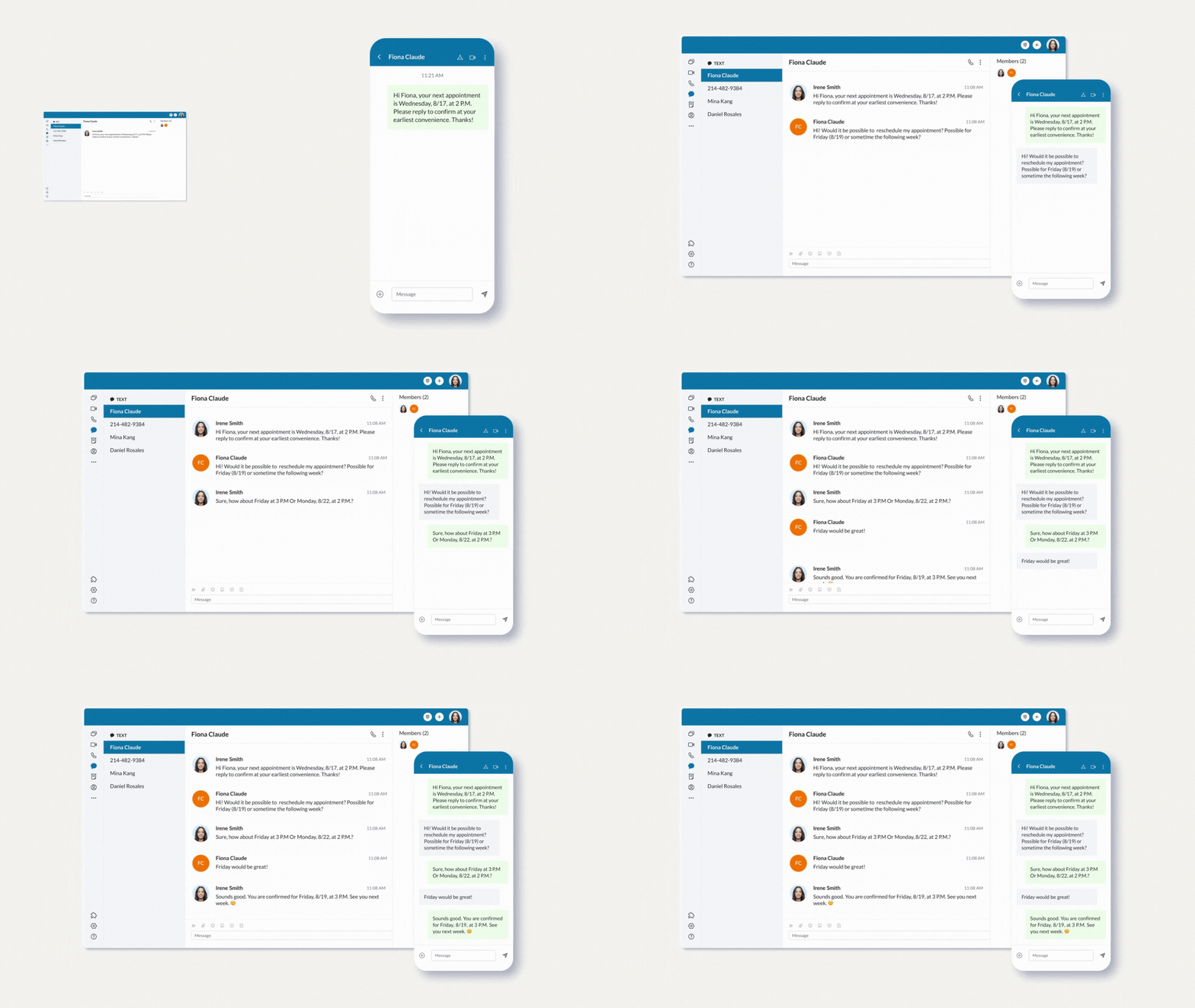
- Outbound reminders and notifications. Conversational AI sends appointment and delivery reminders, then lets customers respond by voice or SMS on the spot rather than waiting for an agent.
- Real-time agent assistance. Conversational AI acts as copilots for human agents by surfacing knowledge, suggesting next steps, and automating after-call work like summaries and disposition codes. McKinsey’s 2025 State of AI report found that 45% of AI-adopting businesses saw greater customer satisfaction, while 38% saw lower operational costs.
Internal operations and employee support
Conversational AI can also streamline internal workflows and reduce friction for employees. Any process that involves opening tickets, calling a help desk, or searching a knowledge base is a potential fit.
Common internal use cases include:
- Automating IT help desk inquiries. AI assistants can write and send tailored SMS messages, compose notes, write chat responses, and record call details. It can even enhance accessibility and document important conversation points in a searchable format.
- Providing HR and workforce management support. Conversational AI paired with conversation intelligence helps you keep better tabs on employee engagement and flag potential problems, so you can continuously train and support your team. It can also track customer interaction trends to inform team approaches and business goals.
- Augmenting field service workflows. Voice-first assistants help frontline workers and technicians access procedures, parts availability, or safety guidelines without stopping to type, which is critical in hands-free or on-the-move environments.
- Optimizing knowledge sharing. Teams ask an assistant for the current talk track, competitive detail, or product spec mid-call instead of digging through a database. These strategic contact center AI use cases reduce ticket volume and administrative work while improving how work feels.
What are the business benefits of conversational AI for enterprises?
For enterprise organizations, adopting conversational AI is ultimately a strategic business decision. The most meaningful benefits typically fall into three areas: customer experience, operational efficiency, and employee empowerment.
Impact on CX and satisfaction
Conversational AI gives enterprises new ways to improve customer experience across every channel. When implemented thoughtfully, it can:
- Reduce wait times. AI can resolve a large share of inquiries instantly, freeing human agents to focus on the remaining interactions. This increases speed of answer and reduces customer abandonment.
- Increase first-contact resolution. By combining user intent recognition with datasets from CRM, billing, and order systems, AI can resolve more issues in a single interaction or equip agents with the context needed to avoid follow-ups.
- Provide always-on support. Voice self-service, chatbots, and messaging apps let customers get help outside standard business hours without waiting for the next shift to start.
- Personalize interactions at scale. AI can recognize customers, reference history, and tailor flows based on segment, product, or past issues to deliver consistent personalization that’s difficult to achieve with human agents alone.
According to Zendesk’s CXtrends 2026 report, conversational AI capabilities such as intent understanding, access to customer data, and conversation history drove a 50% increase in customer satisfaction and a 45% boost in retention.
To track impact, enterprises typically measure customer satisfaction (CSAT), net promoter score (NPS), customer effort score, first-contact resolution, and digital containment. For example, if 20% of password reset calls are deflected to self-service, that improvement can be measured weekly and tied directly to CSAT for that journey.
Operational efficiency and cost reduction
Labor is often the largest cost driver in contact centers and support organizations. Conversational AI helps reduce operational costs while maintaining or improving service quality.
Key operational benefits of AI include:
- Lower cost per interaction. Shifting a portion of volume to AI or augmenting agents with AI assistance lowers average cost per interaction.
- Scalable capacity without linear headcount growth. Since virtual agents don’t require hiring, training, or scheduling, capacity can flex during seasonal peaks or campaigns.
- Shorter handle times and less rework. Real-time guidance, automated summaries, and post-call automation reduce handle time and minimize errors that lead to repeat contacts.
Employee empowerment and retention
High attrition, complex products, and hybrid work have made frontline roles harder to sustain. SHRM CHRO Jim Link explained how conversational AI can act as a real-time assistant and coach, helping meet employees’ expectations for the same level of personalization at work that they experience as consumers.
He noted this is especially prevalent for younger generations who grew up in a personalized world, saying, “It’s no surprise they now expect the same level of customization in their careers. HR leaders who fail to meet these expectations will struggle with engagement and retention.”
When embedded into a calling or contact center platform, conversational AI can support your workforce by:
- Removing repetitive tasks: AI can pre-fill forms, generate call notes, recommend dispositions, and handle routine questions so agents can focus on complex, high-value issues.
- Providing real-time guidance: During interactions, AI can suggest next steps, surface required disclosures, and prompt empathetic responses. Managers gain visibility into patterns like sentiment trends, talk-to-listen ratios, and script adherence for data-driven coaching.
- Making hybrid work more sustainable: Because AI assistance and conversation intelligence are delivered through a cloud communications platform, agents and supervisors get consistent support whether they’re on-site, remote, or in a branch office.
Over time, these benefits help reduce burnout and improve retention, which directly impact company growth and customer experience.
Challenges and limitations of conversational AI
Every serious enterprise deployment has to plan for three limitations of AI: inaccuracy and hallucination, bias, and the trust gap that slows adoption. Here’s what each limitation entails.
1. Inaccuracy and hallucination
Deloitte defines AI hallucinations plainly, noting that AI sometimes “generate[s] outputs that are not based on real-world data or factual information, leading to incorrect predictions, misleading insights, or entirely fabricated data.” For a customer-facing system, a confident wrong answer costs more than no answer.
McKinsey’s State of AI Trust in 2026 found that 74% of respondents identify inaccuracy and 72% cite cybersecurity as highly relevant AI risks. Overcoming this limitation requires data quality: ground the system in verified, current knowledge sources and constrain it from answering outside them.
2. Bias
Bias enters AI systems through training data. TechTarget defines AI bias as a “phenomenon that occurs when an algorithm produces results that are systemically prejudiced due to erroneous assumptions in the machine learning (ML) process.”
In a service context, biased outputs can mean uneven treatment across customer segments, which carries both reputational and regulatory weight. The governance response is human-in-the-loop QA: review outputs across segments, test for disparate handling, and correct the data that feeds the model.
3. Trust and explainability
In McKinsey‘s State of AI survey, 40% of respondents named explainability as a key risk in adopting generative AI, while only 17% said they were working to mitigate it. That survey looked at generative AI adoption broadly rather than contact center deployments specifically, but the gap it describes gets sharper here, where every automated decision lands on a live customer.
The distance between concern and action is where deployments stall. Projects stay parked in pilot, scoped to the lowest-risk interactions because no one wants to defend a decision they can’t reconstruct. Teams route around the problem with tools bought outside IT, which is how AI ends up running with less oversight instead of more.
Oversight closes the gap by logging decisions, making routing and escalation logic auditable, and giving supervisors visibility into why the system did what it did. Internal explainability is the precondition for the external kind. An agent can’t tell a customer why the system routed them if no one inside the business can see it either.
Those same governance signals are exactly what conversation intelligence captures, which is where a QA layer earns its place.
5 best practices for implementing conversational AI at scale
Rolling out conversational AI in an enterprise isn’t just a feature launch. It changes how customers and employees interact with your organization and touches technology, people, and process all at once.
To avoid fragmented or frustrating experiences, focus on these proven best practices.
1. Start with a focused, high-value journey
Begin with a use case that has high volume, clear rules, and measurable outcomes, such as password resets, order status, or appointment changes. Design an end-to-end journey and use it as a pilot to identify data access needs, privacy and compliance requirements, and training gaps.
This is especially critical in regulated industries: healthcare organizations bound by HIPAA, for example, or financial services under strict data-handling rules. Clear policies around data access, retention, consent, and model training, as well as auditability for AI-driven interactions, are essential for managing risk.
2. Leverage your existing communications journey
Whenever possible, layer conversational AI onto your existing cloud communications or contact center platform rather than deploying isolated bots. This preserves voice quality, security, and routing logic while introducing AI in a controlled way.
Deep integration with systems of record, like CRMs, billing, ticketing, and knowledge bases, also allows AI to take real action, not just answer questions.
3. Design human-in-the-loop experiences from day one
Always provide a clear path to a human agent and ensure the full context of each customer interaction travels with the handoff. Include transcripts, sentiment, and recent actions so customers don’t have to repeat themselves.
Poor handoffs are a major pain point, as customers are frustrated when they have to repeat information. Thoughtful flow design and clear escalation paths make human-in-the-loop a core part of the experience, not a fallback.
4. Align IT, customer experience, and KPIs
Conversational AI initiatives stall when ownership and success metrics are unclear. Establish a cross-functional team responsible for roadmap, prioritization, and rollout.
IT can lead security, compliance, and integrations, while CX and operations define journeys, success metrics, and adoption goals. Alignment ensures pilots have clear outcomes and a path to scale.
5. Measure, train, and iterate
Track metrics such as containment rate, average handle time, cost per interaction, CSAT, and agent satisfaction. Use conversation intelligence to understand where AI escalates or drops interactions, then refine flows, prompts, and training data.
Change management is just as important. Agents, supervisors, and stakeholders need to understand what’s changing, how AI supports their work, and why it’s being introduced. Without this clarity, adoption suffers and morale drops.
Turn every customer conversation into intelligence with RingCentral
Sampled QA reviews a few percent of calls and calls it coverage. Blind spots pile up across sales and service, compliance risks surface only after they’ve cost something, and inbound opportunities slip away the moment no one picks up. Closing those gaps takes AI working on the full conversation, start to finish.
RingCentral brings these layers together on a single platform. By combining agentic voice AI with cloud phone, messaging, video, and an omnichannel contact center, you can orchestrate the entire conversation lifecycle in one place:
- AI Receptionist to answer and intelligently route inbound calls
- AI Virtual Assistant to streamline employee workflows and boost productivity
- AI Conversation Expert to provide insights and guidance from conversations and interactions
Since these capabilities are built on RingCentral’s cloud communications network, you get enterprise-grade security, reliability, and voice quality alongside every AI-driven interaction. This foundation makes it easier to move from isolated pilots to a connected AI strategy that spans customers, employees, and partners.
Make conversational AI a measurable advantage
Conversational AI earns its place in the enterprise when you treat it as infrastructure. Define what it is, understand the mechanics well enough to judge where it holds up, plan for the limits that trip up rushed deployments, and measure the return against the metrics your business already tracks.
The organizations pulling ahead are the ones who wired conversational AI into real journeys and held it to real numbers. See how RingCentral applies conversational AI across every customer interaction.
View ACE plans and pricing to see how it maps to your own operation.
Conversational AI FAQs
What is conversation intelligence?
Conversation intelligence is a technology-driven capability that analyzes voice and digital interactions to uncover insights, risks, and opportunities. It uses transcription, natural language processing, and analytics to identify topics, sentiment, compliance signals, and next steps.
When paired with conversational AI, it creates a feedback loop: AI handles and assists in conversations, while conversation intelligence reveals where you can refine flows, training, scripts, and products to continuously improve results.
Is ChatGPT a conversational AI?
In everyday use, yes. ChatGPT is a generative AI that behaves conversationally. But the underlying model matters less than the system built around it.
In an enterprise context, a production conversational AI system adds the parts a raw model lacks: integration with CRMs and knowledge bases, guardrails against inaccurate answers, real-time voice handling, and escalation to human agents.
Which conversational AI is best?
There’s no single best system, only the best fit for your use case. Judge candidates on a few criteria: whether it handles your primary channel well, whether it integrates with the CRM and knowledge sources you already use, how it handles accuracy and escalation, and whether it provides auditable visibility into its decisions.
Prioritize platforms that integrate with your existing communications stack over standalone bots that create another silo.
Why is conversational AI important to customers?
Conversational AI is important to customers because it makes getting help faster and more convenient. Instead of waiting on hold or navigating complex menus, they can simply say or type what they need, even outside business hours.
If customers still need a human agent, conversational AI improves their experience by providing context and guidance, allowing them to spend less time repeating themselves and more time getting their issue resolved.
How do you measure ROI from conversational AI implementation?
You can measure the ROI of conversational AI by tying it directly to cost, productivity, and experience metrics.
On the cost side, track:
- Cost per interaction
- Automation or containment rate
- Volume shifted from high-cost channels (like live voice) to AI-assisted self-service
On the productivity side, monitor:
- Average handle time
- After-call work
- Interactions handled per agent
Then connect those gains to CX outcomes such as CSAT, net promoter score (NPS), and first-contact resolution to show how AI improves both efficiency and satisfaction.
Updated Sep 02, 2026