AI Communications






Compare the platforms, AI agents, and services that shape healthcare call center performance and patient access.
Rising call volumes and staffing gaps put constant pressure on patient access, and the call center software you choose shapes how fast your patients get care. Today’s market spans cloud contact center platforms, AI voice agents, electronic health record (EHR)-embedded tools, outsourced answering services, and legacy phone systems, and each solves a different part of the problem. Picking the wrong type costs more than money. It shows up as longer holds, missed appointments, and patients who look elsewhere for care.
Before you shortlist any vendors, it’s helpful to understand what each category does and where it fits your setting. A high-volume health system has different needs than a five-provider clinic, and a platform built for one rarely serves the other well.
This guide compares 15 healthcare call center solutions across six categories, then outlines the features, patient-experience impact, and evaluation criteria that separate a good candidate from an expensive mismatch.
Key takeaways
- Healthcare call center software brings all patient conversations into one easy-to-manage platform
- Smart routing and AI automation ease pressure on staff while cutting patient wait times
- Native security and HIPAA compliance help keep patient data safe
- EHR and CRM integrations give staff the context to solve issues on the first call
- Unified phone and contact center systems eliminate tech silos and lower overall costs
What is healthcare call center software?
A healthcare call center solution is the combination of platforms, services, and AI that a healthcare organization uses to manage patient interactions across voice and digital channels while keeping patient data protected. It covers appointment scheduling, medication questions, billing, referrals, and post-visit follow-up, and it has to handle both high-stakes conversations and high volumes without breaking.
Two pressures make this urgent right now. Analysis from the Health Resources and Services Administration projects ongoing shortages in key clinical roles, which leaves patient-access teams managing more calls with less capacity. At the same time, patients expect convenience and speed: fewer handoffs, clearer answers, and self-service for routine tasks like rescheduling.
When those options are missing, hold times climb and satisfaction drops. The right solution gives you a way to protect patient data as volume grows, connects to your existing systems, and supports workflows that match how care happens.
Compare 15 healthcare call center solutions at a glance
The 15 solutions below fall into six categories, and the category usually matters more than the vendor name.
Cloud contact center platforms suit health systems that run high volumes across many channels, while AI voice agents focus on automating call intake and scheduling. For smaller practices, UCaaS platforms fold a contact center into a business phone system. EHR-embedded tools keep patient engagement close to the clinical record, and outsourced BPO services hand off call handling entirely. Legacy on-premises systems are often what a modernizing organization is replacing.
| Solution | Solution type | Primary use case | Key capability |
|---|---|---|---|
| RingCentral RingCX | AI-first CCaaS platform | Omnichannel patient interactions | AI quality management across 100% of interactions |
| Parloa | AI-first CCaaS platform | Conversational AI call automation | Agentic voice and chat automation |
| Microsoft Dynamics 365 Contact Center (Nuance) | AI-first CCaaS platform | Clinical voice and documentation | Healthcare-specific speech recognition |
| Hyro | AI voice agent | Call intake and scheduling | Conversational AI for patient access |
| Retell AI | AI voice agent | Automated call handling | Developer-built voice agents |
| 8×8 | UCaaS with contact center | Unified phone and contact center | Combined UCaaS and CCaaS |
| Dialpad | UCaaS with contact center | Unified communications | Built-in AI transcription and routing |
| Talkdesk Healthcare Experience Cloud | EHR-embedded contact center | Patient engagement with EHR context | Pre-built healthcare integrations |
| NICE CXone | EHR-embedded contact center | Enterprise patient engagement | Workforce and journey orchestration |
| OhMD | EHR-embedded engagement tool | Patient texting and communication | Two-way messaging tied to the EHR |
| HelpSquad Health | Outsourced BPO service | Medical answering and support | 24/7 live agents and virtual receptionists |
| Teleperformance Healthcare | Outsourced BPO service | Large-scale patient support | Global multilingual agent capacity |
| Alorica Healthcare | Outsourced BPO service | Member and patient support | High-volume outsourced operations |
| Avaya Aura | On-premises or legacy system | Established call center operations | Configurable on-premises telephony |
| Cisco | On-premises or legacy system | Enterprise contact center | Network-integrated call handling |
AI-first cloud contact center platforms (CCaaS)
This category handles multichannel patient interactions in one cloud workspace, connecting voice, digital messaging, routing, and analytics so agents work from a single view instead of stitching tools together. It fits health systems that run high call volumes and need consistent handling across departments.
AI-first platforms build automation into the core workflow rather than adding it later, which matters when every interaction touches patient access or care coordination.
1. RingCentral RingCX
For health systems managing growing interaction volumes across voice and digital channels, RingCX is an AI-first contact center platform built to handle patient conversations in one place. It suits organizations that want a unified workspace for agents, supervisors, and administrators, with AI working on every conversation rather than a manual sample. RingCX supports the kind of high-volume, multichannel patient access that strains legacy systems, and it connects contact center and communications capabilities to reduce vendor sprawl.
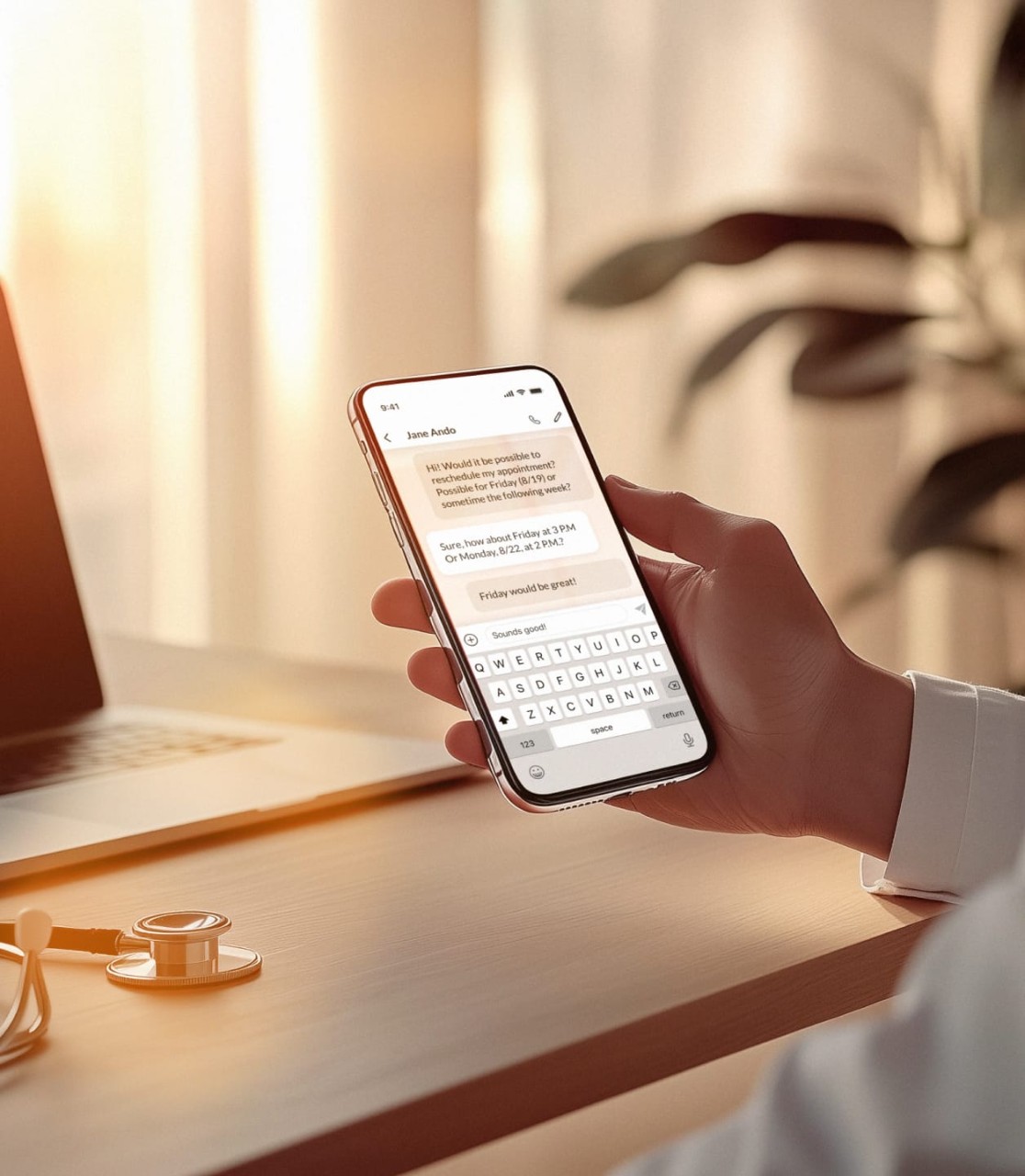
- One workspace for every patient channel: RingCX manages voice, chat, SMS, email, and social patient interactions in a single omnichannel view with AI interaction analytics and intelligent routing.
- Full visibility into call quality: AI Quality Management scores 100% of interactions instead of a manual sample, so supervisors see the whole picture of patient-call quality.
- Real-time agent guidance: AVA Agent Assist surfaces context during interactions so agents spend less time searching and more time resolving.
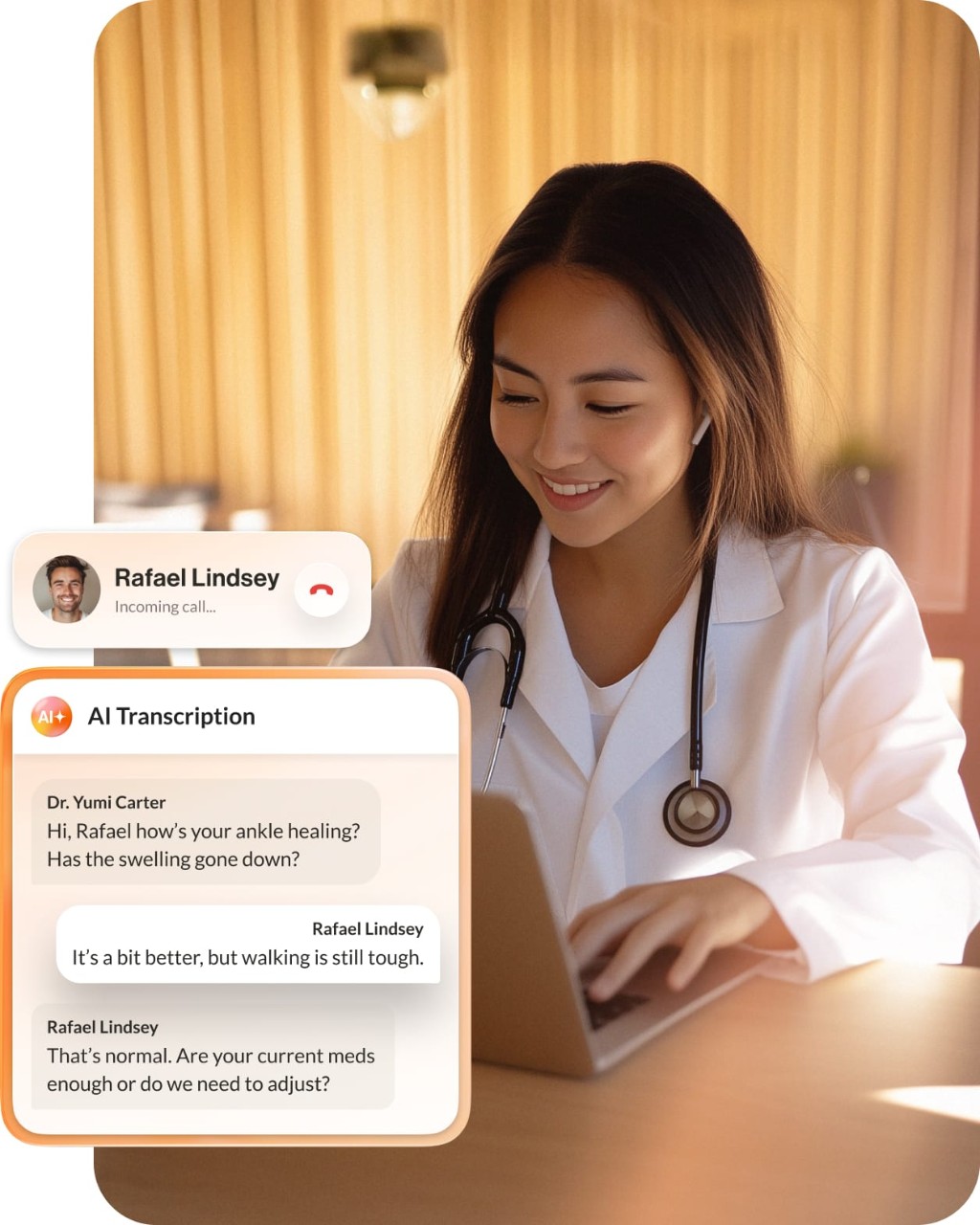
- Less after-call work: Automated interaction summaries handle documentation so agents move to the next patient faster.
- Coverage for inbound calls: Intelligent virtual agents answer inbound calls, route by intent, and support appointment scheduling so after-hours calls aren’t missed.
RingCX supports Health Insurance Portability and Accountability Act (HIPAA)-compliant workflows for organizations that have a Business Associate Agreement (BAA) in place.
AI Representative (AIR Pro) for Healthcare
RingCentral is also building toward AI that handles more of the patient conversation itself, not just assisting agents. AIR Pro (currently in early access) is its agentic AI for healthcare, designed to manage routine patient interactions across voice and SMS, capture caller intent, and escalate to a nurse or coordinator with the conversation context attached. Its pre-built healthcare accelerators are HIPAA-compliant and HITRUST-certified for organizations with a BAA in place.
2. Parloa
Parloa is an AI agent management platform focused on automating voice and chat conversations at enterprise scale. It uses agentic AI to resolve routine contacts and hand off to human agents when a conversation requires escalation. Buyers evaluating it for healthcare should confirm HIPAA support, BAA availability, and how it integrates with existing contact center infrastructure.
3. Microsoft Dynamics 365 Contact Center
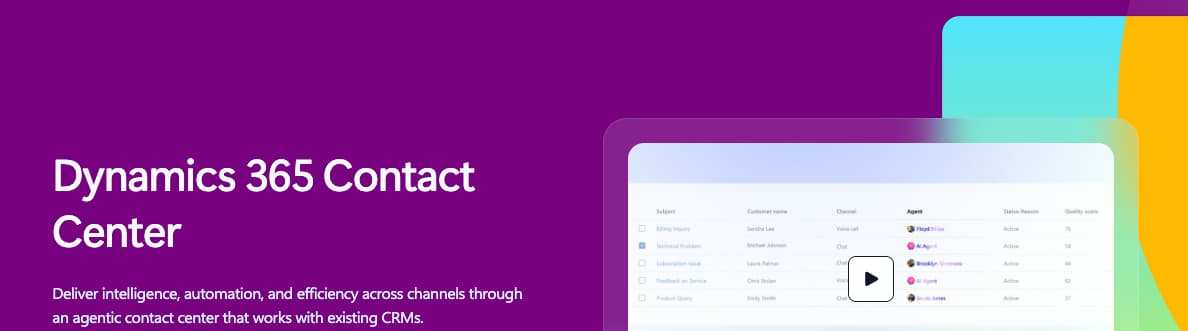
Microsoft’s CCaaS offering pairs Nuance’s interactive voice response (IVR) technology with Microsoft’s cloud AI capabilities. That pairing traces back to Microsoft’s roughly $19.7 billion acquisition of Nuance Communications, completed in 2022, which brought Nuance’s speech and conversational AI in house.
Nuance built its reputation on healthcare-specific speech recognition and clinical documentation tools, developed from years of medical language data, and that heritage carries into how the IVR performs inside Microsoft’s contact center, making it a fit for large health systems that need accurate transcription and clinical context. Organizations evaluating this platform should weigh integration scope, deployment complexity, and how well it fits alongside an existing contact center infrastructure.
AI voice agents for call intake and scheduling
This category automates the front end of the call: answering, routing, and appointment booking, including after-hours coverage. These tools map well to structured, repetitive intents such as scheduling, refills, and directions, which frees staff to handle calls that need a human.
The value shows up fastest where a high share of inbound calls follows predictable patterns. When call reasons are varied or ambiguous, an AI voice agent needs careful design and clear escalation paths to avoid frustrating patients.
4. Hyro
Hyro provides conversational AI voice agents built for healthcare, handling patient calls for scheduling, prescription refills, and general questions. It aims to deflect routine calls from staff while routing complex ones to the right team. You should evaluate how it connects to your EHR and scheduling systems along with how it handles escalation to a human.
5. Retell AI
Retell AI offers a developer-oriented platform for building custom voice agents that answer and handle calls. It suits practices or vendors that want to design their own intake and scheduling flows rather than buy a pre-built healthcare product. Because it’s a building block rather than a turnkey healthcare tool, confirm compliance coverage, BAA availability, and the engineering effort involved.
Platforms with built-in contact center
These unified communications as a service (UCaaS) platforms combine a business phone system with contact center features in one subscription, which fits smaller clinics and practices that don’t need a standalone CCaaS platform. The appeal is simplicity: one vendor for internal calling, messaging, and patient-facing queues. The tradeoff is depth, since contact center features in a UCaaS bundle are often lighter than those in a dedicated platform.
6. 8×8 Work
8×8 Work provides a combined UCaaS and contact center platform covering voice, video, chat, and team messaging in one system. It fits smaller healthcare organizations that want unified communications and basic contact center capabilities from a single vendor. Confirm HIPAA support, BAA availability, and whether its contact center depth matches your patient-access requirements.
7. Dialpad for Healthcare
Dialpad is a unified communications platform with built-in AI features like live transcription and call routing, plus contact center options. It suits growing practices that want AI-assisted calling without a heavy implementation. Evaluate its healthcare compliance posture and how its contact center features scale as volume grows.
EHR-embedded call and patient-engagement tools
This category keeps call handling and patient engagement close to the clinical record, either built into the EHR or connected tightly to it. The advantage is context: agents see patient history, scheduling signals, and prior interactions without switching systems. Because integration depth with your specific EHR is what matters most here, ask specifically about pre-built connections.
8. Talkdesk Healthcare Experience Cloud
Talkdesk Healthcare Experience Cloud is a contact center product built for healthcare, with pre-built workflows and integrations aimed at patient access and engagement. It targets mid-market and enterprise providers that want healthcare-specific templates out of the box. Confirm which EHR integrations are pre-built versus custom and how they map to your systems.
9. NiCE CXone
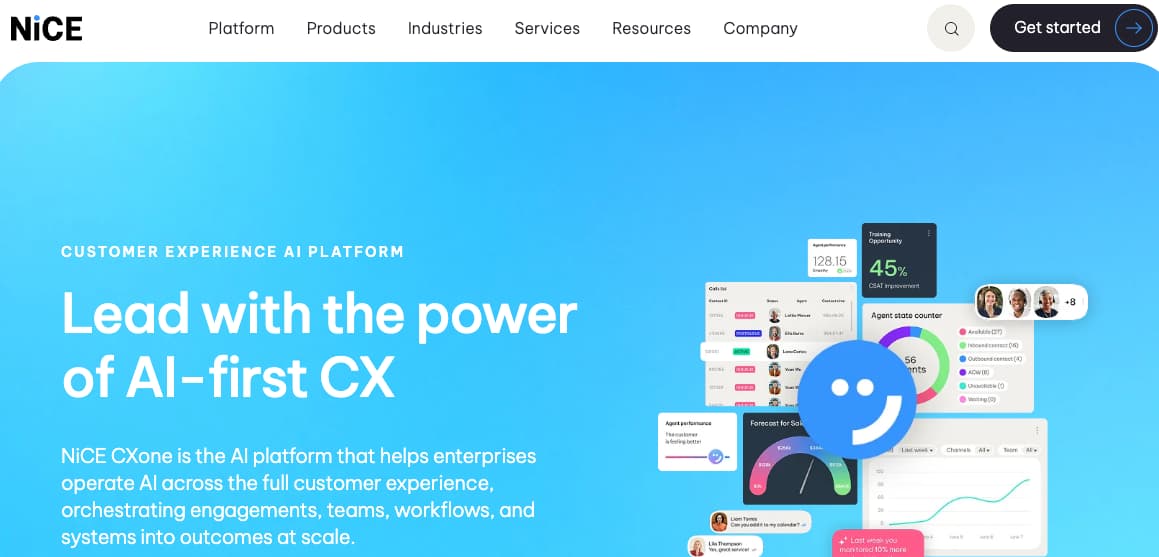
NiCE CXone is an enterprise contact center platform with workforce management, journey orchestration, and analytics used across many industries, including healthcare. It fits large health systems that need deep workforce and routing capabilities. Weigh implementation complexity and the amount of configuration your team needs to tailor it for patient access.
10. OhMD
OhMD is a patient communication platform centered on two-way texting that connects to the EHR for reminders, follow-ups, and secure messaging. It suits clinics and practices that want to reduce phone volume by moving routine communication to text. Because it functions as a communication layer rather than a full contact center, pair it with call handling if you need queue management.
Outsourced medical answering and call center services
Outsourced medical answering is a service rather than software: an outside provider staffs and runs call handling on your behalf, from after-hours answering to full patient support operations. It fits organizations that lack the headcount to staff a medical call center or that need overflow and 24/7 coverage without additional hiring.
The key considerations are control and compliance, so confirm HIPAA training, BAA terms, and how the provider maintains quality and consistency across its agents.
11. HelpSquad Health
HelpSquad Health provides outsourced live agents and virtual receptionists, including 24/7 medical answering and appointment support. It fits practices that want human coverage for calls and chats without building an internal team. Confirm HIPAA compliance, BAA availability, and how agents are trained on your specific workflows.
12. Teleperformance Healthcare
Teleperformance is a global business process outsourcing provider with a healthcare practice that delivers large-scale, multilingual patient and member support. It fits enterprise providers and payers that need high agent capacity across regions. Evaluate onboarding time, quality monitoring, and how well the operation aligns with your compliance and brand standards.
13. Alorica Healthcare
Alorica is a large outsourcing provider offering healthcare member and patient support at high volume. It suits health plans and large providers that want to hand off substantial call operations. As with any business process outsourcing (BPO) partner, weigh oversight, data handling, and how consistently the provider represents your organization to patients.
On-premises and legacy call systems
Many organizations already run traditional, on-premises phone and contact center systems and are often looking to replace them. These systems can be highly configurable and sit close to existing infrastructure, but the limitations tend to show up as operations scale. Compliance upkeep falls on your team, adding channels or capacity means hardware and project work, and native AI is usually absent.
14. Avaya Aura
Avaya Aura is an on-premises communications platform used for established call center and telephony operations. It fits organizations with existing Avaya infrastructure and the IT resources to maintain it. Buyers modernizing patient access should weigh the cost of upkeep and the effort to add modern channels and AI against a cloud migration.
15. Cisco
Cisco offers on-premises and hybrid contact center and calling products that integrate with its broader networking stack. It fits enterprises already standardized on Cisco infrastructure. Consider how its roadmap, deployment model, and AI capabilities compare with cloud-native platforms as your patient-access needs change.
Key features of leading healthcare call center solutions
If you’re evaluating platforms, consider whether they can support your operating model with measurable outcomes: lower wait times, fewer missed appointments, better first-call resolution, and tighter data security. The strongest solutions share a voice-first foundation for high-stakes inbound calls, true omnichannel coverage that carries context across channels, and unified workflows that reduce steps instead of adding them.
Here’s what to look for in each.
Advanced patient communication tools: Voice, SMS, chat, and video
Healthcare doesn’t happen on a single channel. A patient might call to schedule, respond by SMS to confirm, use chat for a quick question, and join a video visit for follow-up. If those channels live in different systems, you lose context, repeat work, and increase risk.
Modern healthcare call center software supports omnichannel communication while maintaining conversation history. This typically includes:
- Voice: Reliable inbound call handling with smart call routing, call recording, and quality metrics
- SMS: Automated reminders, outreach, and notifications that keep patients informed and reduce no-shows
- Chat and chatbots: Fast self-service for high-frequency FAQs
- Video: High-quality video for scenarios where visual context or face-to-face interaction is essential for trust and patient care
If video is part of your patient engagement model, consider how potential video solutions fit into your broader communications stack, including accessibility, workflows, and ease of use across devices. RingCentral is built to meet clinical and patient-facing requirements, ensuring your team stays connected without added technical friction.
HIPAA compliance and healthcare data security
Before you shortlist any solution, verify three things:
- The vendor will sign a BAA
- The vendor holds recognized certifications such as SOC 2 and HITRUST
- The vendor’s security controls hold up in day-to-day agent workflows
A BAA is the contract that makes a vendor accountable for protected health information, and certifications like HITRUST and SOC 2 give you independent evidence of security practices rather than a marketing claim.
At minimum, expect native encryption and access controls mapped to your organization, audit trails for accountability, data-retention controls aligned to policy, and secure handling of recordings, transcriptions, and messaging. If agents rely on workarounds to stay productive, the system will eventually create risk.
RingCentral supports HIPAA-compliant workflows for customers with a BAA in place, which keeps compliance built into the workflow rather than bolted on. Confirm specific certifications and BAA terms directly with any vendor before you decide.
AI-powered automation and intelligent call routing
In the healthcare industry, “AI-powered” doesn’t mean replacing people. The goal is to remove manual hurdles from routine tasks so your team can focus on the patient interactions that require judgment, empathy, and a human touch.
Strong AI-driven capabilities usually show up in three places:
- Automation for routine tasks: Chatbots and AI agents can handle appointment management, status updates, and FAQs. This takes the pressure off inbound queues without making the patient experience feel cold.
- Smart routing that reduces transfers: Intelligent routing uses real-time context—like intent, language, and urgency—to get patients to the right person the first time. This cuts down on repeat calls and frustrating handoffs.
- Agent assistance for improved consistency: AI Assist–style capabilities can surface context during patient calls, help agents stay on script for compliance-sensitive topics, and generate actionable insights from patterns in patient interactions.
If you’re modernizing your infrastructure, it’s useful to align your contact center roadmap with your broader telephony updates, especially as legacy lines become harder to maintain.
How healthcare call center solutions improve patient experience and operational efficiency
When patients can’t get access quickly, they look for care somewhere else. About one in four consumers (24%) say they’d switch doctors if virtual visit options aren’t offered, according to Deloitte. Among consumers who wanted but did not schedule a virtual visit, 33% cited inconvenient appointment times. A call center solution that closes the access gap protects the patient relationships an organization already has.
Reduces wait times and speeds patient access
Reducing wait times isn’t just about speed. It’s also a critical factor in patient access, staff workload, and the revenue impact of missed visits. Since healthcare call volumes frequently surge due to seasonal illnesses, policy shifts, or local events, implementing better routing and self-service tools is essential to keep hold times and abandonment rates from rising.
The gap is already wide. Industry reporting puts the average hold time at US healthcare call centers at 4.4 minutes, more than five times the 50-second benchmark set by the Healthcare Financial Management Association. That is an experience gap patients feel immediately, and it carries a financial cost: reducing no-show rates through contact center modernization can save a mid-sized health system up to $3 million a year.
Modern healthcare call center software addresses this by combining:
- IVR that routes callers quickly to reduce misdirected calls
- Self-service for simple requests so your live queue is reserved for complex needs
- Intelligent call routing that gets the caller to the right agent faster
- Workflow automation that reduces after-call work and repeat calls
By providing actionable insights, these tools allow you to identify call trends, spot routing bottlenecks, and determine where automation can remove friction without compromising the patient experience. Organizations that have modernized their patient access centers see the difference in both hold times and satisfaction.
Improves care coordination and follow-up
Patient care is rarely a straight line. People move between departments, providers, labs, and billing throughout their treatment. If your contact center can’t coordinate across those touchpoints, your staff ends up manually stitching the journey together.
Integrating your EHR and CRM helps turn this fragmented data into an operational asset. When agents have a clear view of patient history and prior interactions, they can resolve inquiries faster and provide more consistent instructions.
Proactive follow-up also helps reduce no-shows and strengthen patient engagement. While reminder programs aren’t a heavy lift, they do require reliable workflows and channel flexibility.
Patient expectations around this kind of convenience aren’t going away. RingCentral’s perspective on what consumers want from digital healthcare experiences reinforces the shift toward responsiveness, flexible channels, and smoother coordination across touchpoints.
How to choose the right healthcare call center solution
At this stage, you are likely comparing a short list of finalists. The fastest way to choose among these platforms is to evaluate them against your enterprise requirements and operational realities. Start with your deployment model and compliance fit, as that decision narrows the field faster than any feature comparison.
Call demand shows why the stakes are real. HealthTech Magazine reported that call centers are a hospital’s largest-volume patient interaction function, noting that AI-powered intent analysis, predictive routing, and AI agents are technologies that support a more mature, modern healthcare call center solution.
To find the best fit for your organization, work through these five steps in order.
1. Start with compliance and data protection, then validate operational fit
Ask how the system enforces HIPAA-compliant handling of patient data across voice, SMS, and digital channels. Then ask what the platform does to make compliance easier for agents inside day-to-day workflows.
What you want to hear isn’t just “we support HIPAA compliance.” You want to hear how the system enforces policy through permissions, logging, retention controls, and secure integration patterns.
2. Confirm that omnichannel really means unified
Many vendors claim omnichannel but still split channels behind the scenes, leading to duplicated work and lost context.
Validate whether agents can manage voice, SMS, and chat in a single interface with a unified patient history. This isn’t just a convenience—it’s how you prevent medical errors and patient frustration.
3. Make EHR and CRM integrations nonnegotiable
Your contact center must function as the hub for your existing technology. Look for deep, out-of-the-box integrations with:
- EHR systems: For patient context, scheduling signals, and follow-up workflows
- CRMs: For tracking patient interactions and outreach
- Operational workflows: For notifications, escalations, and documentation
4. Demand mission-critical reliability and scale
Healthcare never shuts down, which makes reliability a patient-safety priority. Focus on:
- Scalability that maintains performance during sudden volume spikes
- Reliability backed by stringent service level commitments
- Support models that extend far beyond initial onboarding
To further reduce complexity, consider a “single-vendor” strategy. RingCentral’s RingCX contact center platform is built for organizations that want a contact center solution that supports routing, automation, analytics, and omnichannel communication under one roof.
5. Look at total cost of ownership (TCO), not just seat pricing
The sticker price is part of the conversation, but TCO is where the decision gets real. Factor in:
- Efficiency gains from automation and streamlined workflows that reduce manual labor
- Better clinical outcomes driven by automated reminders that lower no-show rates
- Operational consolidation that removes the drag of managing multiple disconnected tools
If your team is also modernizing broader healthcare communications, RingCentral’s breakdown of cloud communications use cases in healthcare can help you map your technology choices to wider operational goals.
Give patients faster, more reliable access to care
The single most important thing you’re buying is fit: a solution that matches your compliance requirements and moves the patient-access numbers that matter, from hold times to no-shows. Capabilities and evidence of security and integration come before any feature demo. Get those right and the rest of the comparison gets much simpler.
For health systems consolidating tools, RingCX unifies patient interactions and AI quality management in one contact center platform, with support for HIPAA-compliant workflows through a BAA. See how RingCentral’s healthcare communications solutions handle high-volume patient calls across every channel in your organization.
FAQs about healthcare call center software
How does AI improve a healthcare call center?
AI automates routine, high-volume tasks like appointment management, status updates, and FAQs, which eases the pressure on staff and shortens queues. It also routes calls by intent, language, and urgency so patients reach the right person on the first try. During live calls, AI can surface patient context and keep compliance consistent.
Are healthcare call center solutions HIPAA compliant?
HIPAA compliance depends on the vendor and how you configure the solution, not the category alone. Before shortlisting, confirm the vendor will sign a Business Associate Agreement (BAA) and holds recognized certifications such as SOC 2 and HITRUST. Verify certifications and BAA terms directly with each vendor.
Do healthcare call center solutions integrate with EHR systems like Epic, athenahealth, and Cerner?
Many do, but integration depth varies widely, so treat it as a specific evaluation question rather than a checkbox. Ask which integrations are pre-built versus custom for the systems you run, including Epic, athenahealth, and Oracle Health-Cerner. Deep EHR integration gives agents patient context that speeds resolution and follow-up.
How much do healthcare call center solutions cost?
Cost depends on the solution type, the number of agents or seats, the channels and AI features you enable, and whether you buy software or an outsourced service. Rather than comparing seat prices alone, weigh total cost of ownership, including automation savings, fewer no-shows, and the cost avoided by consolidating tools. Most vendors provide custom pricing based on your volume and requirements.
Updated Sep 02, 2026