AI Communications











Artificial intelligence is no longer a futuristic concept in retail—it’s a reality shaping customer interactions and retail operations today. As we’ve explored in our previous posts on AI adoption and security challenges, the retail sector is at the forefront of integrating AI into customer-facing processes.
But for many retail businesses, the more pressing question isn’t whether AI matters. It’s where to invest, how to prioritize, and what happens if you wait too long.
Rising customer expectations, tighter labor markets, and increasing pressure to perform at scale have pushed AI investment in retail from “nice to have” to a genuine business necessity. Retailers who get this right are seeing measurable gains in customer satisfaction, agent performance, and operational efficiency. In contrast, those who don’t risk falling behind.
Key Takeaways
- AI investment in retail is no longer discretionary, with 96% of retail decision-making leaders expecting AI spending to grow over the next three to five years and the majority projecting increases of 25% or more.
- Customer-facing applications deliver the most immediate returns, with retailers reporting measurable gains in satisfaction, personalization, complaint reduction, and conversion rates as direct results of AI adoption.
- The cost of inaction is concrete, as retailers that delay AI investment face longer resolution times and a widening capability gap against competitors already scaling AI-driven workflows.
- The retailers seeing the strongest results start with a single, well-defined AI use case, establish clear success metrics before deployment, and scale deliberately based on what the data actually shows.
Where retail AI investment is heading
Recent data from RingCentral’s report on AI in retail communications shows 96% of retail decision-makers expect their company’s investment in AI tools to grow over the next three to five years. This near-unanimous projection underscores the recognition of AI’s transformative potential in the industry.
Breaking down these projections, we see a clear inclination towards substantial increases in AI spending:
- 13% project an increase of 75-99%
- 31% expect significant growth between 50-74%
- 38% anticipate a solid increase of 25-49%
- 13% foresee a more modest rise of 10-24%
Only 3% of respondents expect no change in AI investment, while fewer than 1% predict a decrease.
Three factors are driving this acceleration:
- Shifting consumer behavior: Customers now expect faster service and seamless experiences across an omnichannel landscape—from phone to chat to social—and increasingly across e-commerce platforms as well.
- Labor market pressures: Finding and retaining skilled customer-facing staff remains difficult, making AI-driven workflows increasingly valuable, particularly for streamlining supply chain and demand forecasting processes that once required large analyst teams.
- Rising digital expectations: The rapid shift to e-commerce has permanently raised the bar for responsive, consistent customer experiences, especially as machine learning enables more accurate predictive analytics across every customer touchpoint.
For retail leaders weighing their own investment decisions, the signal from peers is hard to ignore. Being in the 3% that holds steady on AI spending isn’t a neutral position but a competitive risk.
What are the benefits of using AI in retail
Investment projects tell you where the industry is heading, but actual results tell you whether the direction is worth following. In retail, the data strongly suggests it is.
Every respondent in the survey reported experiencing at least one benefit from using AI to analyze conversational data.
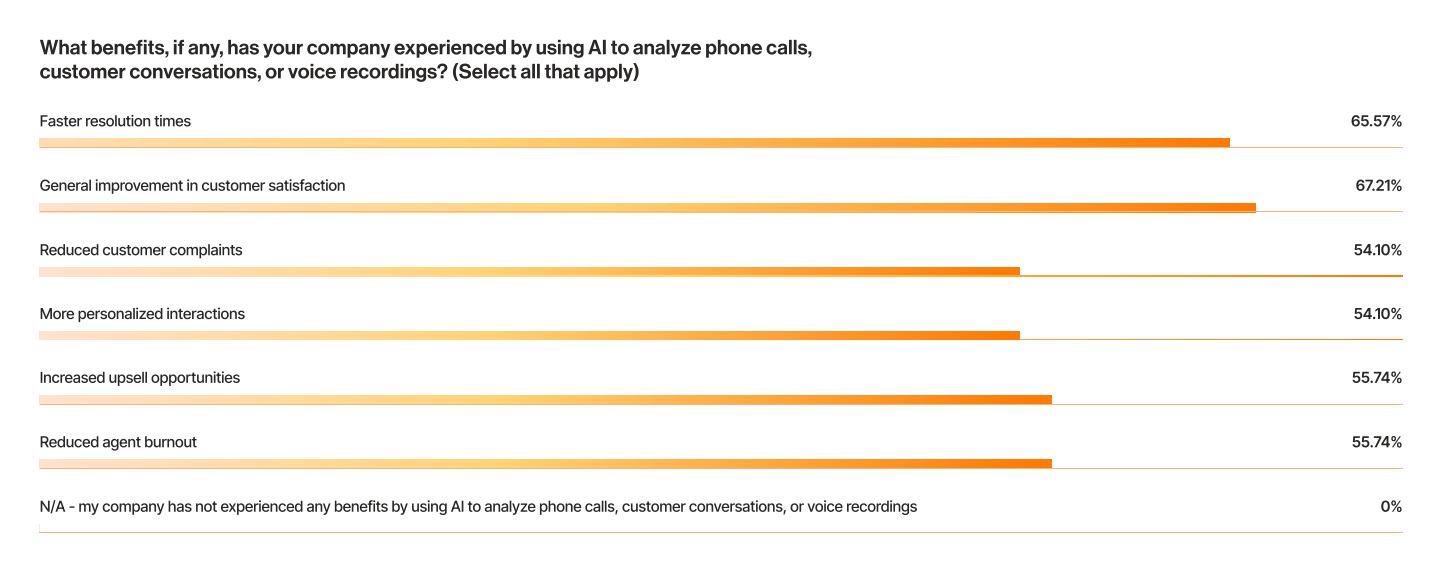
To make sense of these benefits, it helps to group them into two categories:
Customer-facing benefits
- improvement in customer satisfaction
- more personalized interactions
- reduced customer complaints
AI isn’t just speeding up existing processes; instead, it’s changing the quality of the customer experience itself. Machine learning models analyze patterns across thousands of interactions to surface the right response at the right moment. Chatbots and AI agents powered by natural language processing handle routine inquiries around the clock, delivering a personalized shopping experience. This level of automation helps retailers optimize every stage of the customer journey without adding headcount.
Operational benefits
- faster resolution times
- reduced agent burnout
- increased upsell opportunities
- improved conversion rates
AI helps streamline store operations, from in-store merchandising workflows to loss prevention monitoring. When agents aren’t manually searching for information or handling repetitive queries, they can give full attention to the conversations that actually require it.
Predictive analytics helps teams anticipate demand patterns, allowing managers to allocate resources more effectively and improve conversion rates across key touchpoints. Post-interaction data analytics give retail teams a continuous stream of insight—informed by customer feedback—for improving processes, pricing strategies, and service quality.
What is the cost of falling behind on AI in retail
The benefits case for AI largely speaks for itself. What gets less attention is the operational and competitive toll of delaying that investment.
Retail leaders cited longer process times and decreased customer satisfaction as potential consequences of not adopting AI technologies. Without data-driven tools to guide decision-making, teams are left reacting to problems rather than anticipating them.
A customer who waits too long or feels underserved doesn’t just leave that conversation frustrated. They’re less likely to return, less likely to recommend your brand, and increasingly likely to share a negative experience publicly. In retail, where word of mouth and repeat business carry significant weight, that kind of erosion adds up quickly.
There’s also a competitive displacement factor worth considering. As more retailers deepen their machine learning capabilities and scale AI agents across their omnichannel operations, the gap between what they can offer and what traditionally run operations can deliver continues to widen.
Customer expectations are shaped by the best experience they’ve had, not the average one. When AI-driven competitors raise that bar, businesses without comparable tools are measured against a standard that’s increasingly difficult to meet through manual processes alone.
The question for retail decision-makers, then, isn’t really “should we invest in AI?” Data from the report effectively answered that. What deserves attention now is figuring out where to start and how to make sure the investment actually delivers.
Where to focus your AI in retail investment first
Not all AI investments deliver equal returns, and the data presented in the AI in retail communications report offers some useful direction here.
Among all industries surveyed in the report, retail businesses lead the way in fully integrating AI into customer conversations—a clear signal that customer-facing applications appear to offer the most immediate returns. It’s a trend worth paying attention to, particularly for retailers still deciding where to direct their first meaningful AI investment.
What does “full integration” look like in practice? It typically means AI is embedded end-to-end across the customer communication journey, not just available as an add-on feature. That includes:
- Intelligent call routing powered by natural language processing to connect customers to the right resource the first time
- AI agents and virtual assistants, including chatbots, that handle routine inquiries without agent involvement
- Real-time agent assist tools that surface relevant information during live conversations
- Post-interaction data analytics that identify patterns, gaps, and coaching opportunities
For retailers just beginning to build out their AI strategy, a layered approach tends to work well:
- Start with customer-facing touchpoints: Phone, chat, and messaging channels where AI can streamline friction and improve response times immediately
- Layer in operational tools: Workforce management, quality monitoring, and AI-assisted scheduling to reduce overhead and improve team performance
- Scale with data and insights: Use conversation analytics and predictive analytics to identify what’s working, where gaps exist, and how to continuously improve
These AI use cases reflect the areas where investment often delivers the fastest, most measurable returns for retail operations teams.
RingCentral’s AI-powered communications platform is built to support this kind of layered deployment, from AI Receptionist (AIR) for automated call handling to AI Conversation Expert (ACE) for cross-conversation analytics. Each tool is designed to integrate with your existing workflows rather than replace them wholesale, which lowers the barrier to adoption and accelerates time to value.
How to get the most out of your AI in retail investment
Knowing where to invest is one part of the equation, and knowing how to invest wisely is the other. Here are five considerations worth working through carefully before committing budget:
Align AI tools with your specific customer journey
The most effective AI investments don’t start with a product selection; they start with a clear picture of how your customers actually interact with your brand, whether through e-commerce channels, in-store visits, or contact center interactions. Map out every key touchpoint across your retail operations, from the moment a customer first reaches out to post-purchase follow-up. Consider answering these questions:
- Where are wait times longest?
- Where do agents feel most stretched?
- Where do customers drop off or escalate?
Those friction points are your highest-priority opportunities for AI. Starting there means your investment is grounded in real operational need rather than technology for its own sake, which makes a meaningful difference in how quickly you see results.
Prioritize integration with existing platforms
Even the most capable AI systems will underdeliver if they can’t communicate with the systems your team already relies on. AI that operates in isolation tends to create new inefficiencies rather than resolve existing ones. It duplicates data entry, fragments customer records, and adds steps to workflows that should be getting simpler, not more complicated.
When evaluating solutions, look for tools that integrate cleanly with your existing communication stack, customer relationship management (CRM) system, and data infrastructure. This is especially important for supply chain, demand forecasting, merchandising, and pricing functions—areas where disconnected AI systems can undermine the accuracy of every downstream models.
Seamless integration is what allows machine learning algorithms to deliver accurate, consistent, and data-driven results from day one and continue improving as your data grows.
Ensure data privacy and compliance from the start
Retail businesses handle a significant volume of customer data across every interaction, including purchase history, contact preferences, and support conversations. As AI systems become more deeply embedded in those interactions, how that data is collected, stored, and used becomes a more pressing responsibility for retail leaders.
Any investment in AI should come with a clear data governance plan built in from the beginning, not bolted on after deployment. Regulations around AI and consumer data continue to evolve, and retailers who address compliance early will be far better positioned to adapt without disruption down the line.
Define what success looks like before you deploy
One of the most common mistakes retailers make when investing in AI is deploying first and measuring later. Without a clear baseline, it becomes difficult to demonstrate value, identify what needs adjustment, or build the internal case for scaling further.
Before going live with any AI initiative, establish the metrics that matter most to your business. Resolution time, customer satisfaction scores, agent utilization rates, conversion rates, and cost per interaction are all strong starting points. Customer engagement metrics should also factor into your baseline as they reflect the quality of every interaction your AI touches.
Documenting those numbers in advance gives your team a shared definition of success and makes ongoing optimization significantly easier to manage and communicate.
Start focused, then scale deliberately
It can be tempting to deploy AI across multiple channels and functions at once, especially when the potential upside is this clear. In practice, broad simultaneous rollouts often lead to inconsistent results, slower adoption, and team fatigue that stalls momentum.
A more effective approach is to start with a single, well-defined AI use case. Pick one channel, one team, and one problem to solve. That focused deployment becomes your proof of concept, generating real performance data to learn from, building internal confidence, and creating a repeatable model that is much easier to scale across the rest of the business. Each rollout is also an opportunity to refine the automation rules and workflows that will carry into subsequent deployments.
Retailers who take this approach often move faster in the long run, not slower. Each step is informed by what actually worked in practice, which makes every subsequent deployment more targeted and more likely to deliver the outcomes your business is aiming for.
Successful AI in retail starts with the right foundation
The industry data is clear, the benefits are documented, and the cost of holding back is becoming harder to absorb, competitively and operationally.
Speed of deployment isn’t what separates the retailers outpacing their competitors—clarity of purpose is. The businesses seeing the strongest results identified where AI could make an immediate difference in their retail operations. They started there, proved it worked, and scaled from a foundation of real performance data.
Executing these initiatives well requires not just the right tools, but a strategy that connects your customer-facing AI to your broader operational systems and continuously improves the customer experience over time.
RingCentral’s AI solutions are designed to support that journey, from taking your first steps with automated call handling deployment to a fully integrated, AI-powered customer communication strategy.
If you’re ready to explore what that looks like for your retail business, we’re here to help you figure out where to start. Contact us today to learn more about our all-in-one AI-powered communication and contact center solutions.
AI in retail FAQs
How is AI being used in the retail industry?
AI is being used across the retail industry to streamline both customer-facing and operational workflows.
On the customer side, common applications include AI-powered call routing, virtual assistants, personalized product recommendations, and real-time agent assist during live interactions. Meanwhile, on the operational side, retailers are using AI for workforce scheduling, quality monitoring, conversation analytics, supply chain management, demand forecasting, loss prevention, and inventory management.
How is AI changing user experience in the retail industry?
AI is changing retail user experience by making every customer interaction faster, more personalized, and more consistent across channels.
AI virtual and phone agents handle inquiries around the clock—resolving pricing inquiries, order status updates, and appointment scheduling automatically so human agents can focus on conversations that need their full attention. During live interactions, real-time agent assist tools surface relevant customer data and suggested responses instantly to make every exchange feel more informed and less transactional.
After each interaction, post-interaction analytics identify friction points and surface patterns across thousands of conversations to help retailers make targeted improvements that compound over time.
Will AI replace our store associates and customer service agents?
No, AI will not replace store associates or customer service agents. The technology is designed to handle repetitive, high-volume tasks through automation, freeing your human team to focus on complex problems, relationship-building, and high-value interactions that require empathy and judgment.
Retailers seeing the strongest results treat AI as a capability multiplier, not a headcount reduction strategy. The goal is a workforce that is better supported, better informed, and better positioned to deliver service that builds long-term customer loyalty across all retail operations.
Updated May 13, 2026