AI Communications





A practical guide to enterprise-ready AI virtual assistants with in-depth comparisons of the features that matter at scale.
Running complex operations across teams, channels, and locations means you need more than a basic bot. An AI virtual assistant automates routine tasks, surfaces critical information, and handles complex communication workflows across multi-site operations. Built for operations and IT leaders, enterprise AI virtual assistants connect directly to business phone and messaging systems to support staff during live customer conversations.
Key takeaways
- An AI virtual assistant understands intent and acts across your tools, which separates it from a rules-based chatbot
- Business AI virtual assistants fall into five groups: productivity assistants, employee and agent assist tools, customer virtual agents, sales conversation tools, and analytics tools
- AI virtual assistant solutions serve different functional needs, from RingCentral across enterprise phone systems to Microsoft Copilot across desktop office software
- Security and compliance posture, depth of system integrations, and outcome-focused analytics are the three areas that matter most when evaluating your options
- The strongest enterprise deployments support customers and employees before, during, and after every conversation
What is an AI virtual assistant?
In a business context, an AI virtual assistant is an AI-powered assistant that integrates with your existing tools to help employees handle routine work more efficiently. It reads or listens to a request, works out what the person wants, and then takes an action, such as summarizing a call, drafting a reply, or updating a record.
Depending on the vendor, you may see it called a conversational AI assistant, an intelligent virtual assistant (IVA), or an AI assistant. All three terms describe a system that understands natural language, takes action, and improves with interaction data over time.
What an AI virtual assistant does for teams
A business AI virtual assistant does four things well:
- Captures: records calls and meetings, then produces transcripts, summaries, and action items so nobody has to take notes by hand
- Finds: looks up past conversations, policies, and customer history when you ask
- Acts: drafts messages, sets up next steps, and updates records such as a CRM entry
- Guides: gives step-by-step help and prompts when someone needs them
Under the hood, these tools rely on four conversational AI technologies:
- Automatic speech recognition (ASR): Converts spoken phone conversations into text streams with little delay
- Natural language processing (NLU): Identifies caller intent, sentiment, and key topics from unstructured speech or text
- Retrieval-augmented generation (RAG): Pulls answers from verified company sources, such as internal wikis and CRM history, so the assistant doesn’t make things up
- Agentic task execution: Updates CRM records, files support tickets, sends follow-up SMS confirmations, and routes complex calls to specialized human teams.
Enterprise AI virtual assistants differ from consumer assistant tools like Siri or Alexa, which handle individual commands. They connect to unified communications as a service (UCaaS), contact center as a service (CCaaS), customer relationship management (CRM), and IT service management (ITSM) platforms, with access controls that business data requires.
Virtual assistant AI examples
Modern businesses deploy different AI virtual assistants depending on whether they need to streamline internal schedules or manage multi-channel customer communications. These examples of AI virtual assistants cover the five forms you’ll see most often:
- Productivity assistants: AI tools that connect to calendars, email, and knowledge bases to streamline scheduling, note-taking, and follow-ups to help employees stay focused on higher-value work.
- Agent- and employee-assist AI: AI assistants that support people during calls, chats, or meetings by surfacing relevant information, capturing summaries, and suggesting next steps.
- Virtual agents and AI chatbots for customer support: Automation tools designed to handle routine inquiries, provide self-service, or route requests before a human agent gets involved.
- AI sales assistants and conversation intelligence: Systems that analyze conversations, highlight key moments, and help sales teams prioritize opportunities.
- AI-powered analytics and insight assistants: Tools that analyze interaction and operational data to show what’s working, what isn’t, and where to improve.
RingCentral centers its virtual assistant capabilities around RingCentral AVA (AI Virtual Assistant) inside RingEX, supported by AIR (AI Receptionist) for front-end call intake and ACE (AI Conversation Expert) for post-call intelligence.
6 AI virtual assistants ready for enterprise scale
Selecting the right enterprise ai virtual assistant requires evaluating voice and messaging coverage, security compliance posture, pre-built integrations, and operational analytics capabilities. The six platforms below offer enterprise-grade capabilities tailored to specific productivity and customer experience requirements.
| Solution | AI features | Best for | Enterprise-grade security and compliance | Analytics and conversation intelligence | Integrations | Availability and pricing |
| RingCentral AI (AVA, AIR, and ACE) | Auto-summaries, transcripts, and translations; customizable prompts and workflows; logs customer sentiment; sales coaching and call insights | Teams running high call volume who need assistance before, during, and after conversations | SOC 2 Type II, ISO 27001, PCI DSS, HIPAA, GDPR | AVA: real-time summaries and transcripts. ACE: post-interaction sentiment and trends. | 500+ | AVA included with paid RingEX plans ($20 to $35, skills vary by tier); AIR starts at $39, ACE at $60. |
| Microsoft Copilot | Works with Microsoft 365 to write, analyze and summarize data; uses Microsoft Graph to gather data context | Organizations already using Microsoft 365 who want AI inside existing productivity tools | ISO 27001, HIPAA, GDPR, ISO 42001, EU AI Act | Custom reports and dashboards | 100+ | Add-on to a Microsoft 365 plan at $21. Business plans start at $23.50, Enterprise at $30. |
| Motion | Optimizes calendars and scheduling based on priorities; includes task manager and meeting assistant | Individuals and small teams focused on time management and scheduling | SOC 2 Type II, ISO 27001, GDPR, HIPAA | Personal productivity insights only | 10+ | Individuals plans start at $29/month; Teams at $19 per seat per month. |
| Reclaim.ai | Optimizes schedule for deep work and time blocking; includes time tracking and calendar sync tools | Teams wanting to protect focus time and balance workloads across busy calendars | SOC 2 Type II, GDPR, Microsoft 365-certified | Forecasts and productivity insights | 10+ | Free Lite plan. Paid plans from $10 per seat. |
| Dialpad AI | Transcripts and summaries, agent talk tracks and coaching; logs customer sentiment | Sales and support teams wanting AI coaching built into a single phone and meetings product | SOC 2 Type II, HIPAA | Real-time analytics, proprietary benchmarks | 100+ | Connect from $15, Sell from $39, Support from $80. |
| Crescendo.ai | Resolves customer support queries with AI across live chat, phone, SMS, and email; human-like tone and smart decision-making skills | B2B and B2C companies wanting to automate a high volume of customer support tickets at scale | SOC 2 Type II, HIPAA | Real-time analytics for all support queries. Tone, intent, and sentiment analysis. Automated CSAT scores. | 300+ | $1.25 per resolution plus a fixed monthly fee. Request a quote. |
1. RingCentral AI (AVA, AIR, ACE)
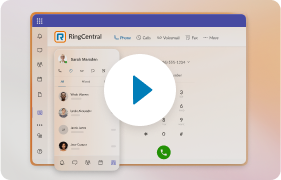
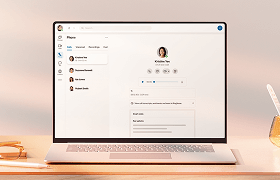
RingCentral approaches AI virtual assistants as part of a communications-native platform, not a standalone productivity tool. At the center is its AI Virtual Assistant (AVA), which supports employees and agents during live calls, meetings, and conversations inside RingEX.

Features now available: Call and meeting notes, summaries, transcripts, message drafting, and translation, included with paid RingEX plans (skills vary by tier).
Coming soon/early access: In-app prompts, guided task help, administrative setup, and support for agents and supervisors during customer interactions.
How AVA supports employees in real time
RingCentral AVA works directly inside RingCentral’s communications environment to surface relevant information, capture key details, and generate summaries and next steps as conversations happen. This real-time assistance reduces manual follow-up and shortens after-call work, helping teams respond more consistently. In fact, 92% of organizations see RingCentral AI Call Notes as important to their business after deployment.

How AIR and ACE extend AVA across the conversation lifecycle
AVA works alongside other RingCentral AI capabilities that support different moments in the conversation lifecycle:
- AI Receptionist (AIR) manages customer-facing call intake and routing before an agent joins, helping inbound calls reach the right destination quickly.
- AI Conversation Expert (ACE) analyzes interaction data after conversations end to surface trends, sentiment, and performance insights that help teams improve outcomes over time.

Together, AVA, AIR, and ACE give teams AI support before, during, and after conversations, all within a single communications platform.
Because these AI capabilities run on RingCentral’s enterprise-grade communications platform, organizations also benefit from built-in security, compliance, and data protections across voice, messaging, and analytics. This integrated approach eliminates the need to stitch together separate tools for assistance, routing, and insight.
Why RingCentral stands out
RingCentral combines real-time employee assistance, customer-facing automation, and conversation intelligence in one platform. For organizations that rely on calls and messaging, this can make it easier to scale AI support.
Take AVA for a spin to see how it can lighten your teams’ workloads.
See how AVA works and join the early access waitlist.
2. Microsoft Copilot
Microsoft Copilot is Microsoft’s AI assistant embedded across Microsoft 365, Teams, and related services. It helps employees draft content, summarize meetings and documents, and query enterprise data using natural language across the Microsoft ecosystem.
This makes Copilot a strong fit for organizations that rely heavily on Microsoft 365 and want AI assistance tightly integrated into everyday productivity tools rather than communications or contact center workflows.

Key features:
- Native Microsoft 365 integration: Work directly inside Teams, Outlook, Word, Excel, and PowerPoint to generate content, recap meetings, and analyze data without changing tools.
- Context from your work data: Draws on email, documents, and calendars through Microsoft Graph to ground answers in your own information.
- Connectors and agents: Extend Copilot with connectors that bring in third-party data, and with agents built in Copilot Studio.
3. Motion
Motion is an AI-powered productivity assistant focused on calendar-based scheduling. It automatically plans tasks, meetings, and projects by turning to-do lists into a prioritized, time-blocked schedule that adapts as meetings move or priorities change.
This approach works best for individuals and teams looking to optimize time, reduce manual planning, and protect focus time, especially in environments centered on knowledge work rather than customer-facing communications.

Key features:
- Automatic calendar scheduling: Turn task lists into a prioritized, time‑blocked schedule that adapts when meetings move or priorities shift.
- Project and task management: Assign work, set deadlines, schedule meetings, and let Motion reshuffle daily schedules automatically as dependencies and capacity change.
- Focus-time protection: Reserve uninterrupted blocks for deep work to reduce fragmentation and context switching.
4. Reclaim.ai
Reclaim.ai, now part of Dropbox, is an AI-powered scheduling assistant designed to help individuals and teams protect focus time and balance workloads. It works primarily through calendar optimization, automatically reserving time for deep work, recurring tasks, and priorities while adapting schedules as meetings and availability change.
Reclaim.ai is best suited for teams that want more control over how time gets allocated across busy calendars, especially within productivity-centric environments.

Key features:
- AI-driven time blocking: Automatically schedule focus time, habits, and tasks around meetings to protect deep work and prevent calendar overload.
- Smart meeting controls: Support recurring events, no-meeting days, and flexible scheduling rules through a customizable meeting assistant.
- Workload and time insights: Track personal and team scheduling patterns to forecast focus time, identify overload risk, and highlight productivity trends.
5. Dialpad AI
Dialpad AI runs across Dialpad’s cloud phone, contact center, sales, and meeting products. It focuses on conversation support for sales and support teams, with real-time transcription, in-call guidance, and post-call analytics.
This makes Dialpad AI a strong fit for teams that want AI features tightly integrated into a single voice and meetings stack, especially when they prioritize coaching and conversation insights.

Key features:
- Real-time transcription and summaries: Capture conversations automatically so agents and reps stay engaged instead of taking notes.
- Live agent assist: Surface prompts, FAQs, and suggestions during calls based on what the customer says.
- Post-call analytics: Analyze keywords, sentiment, and trends to coach teams and refine scripts.
6. Crescendo.ai
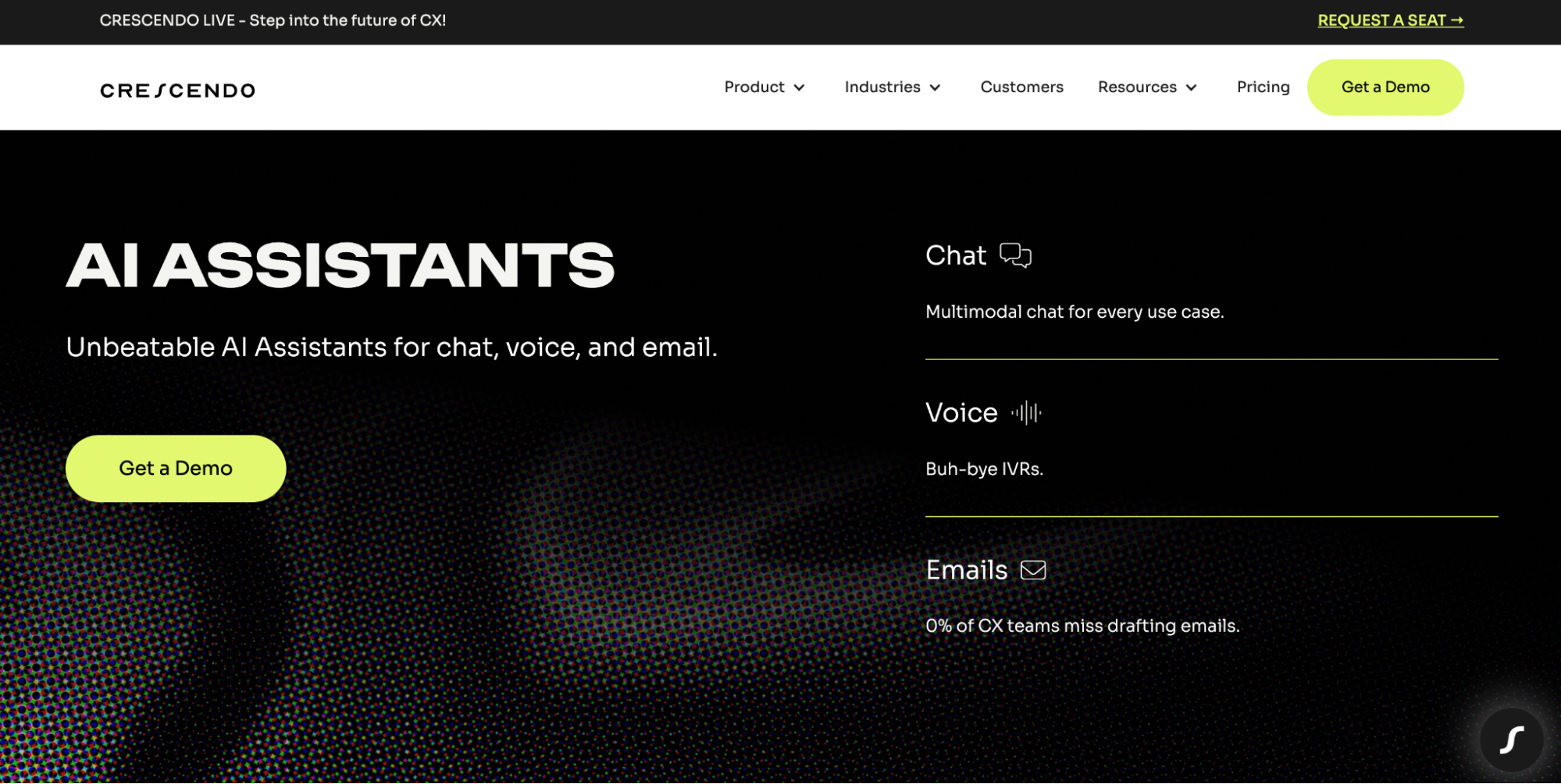
Crescendo.ai is built to handle customer service conversations from start to finish across chat, voice, SMS, and email. Its platform is designed to resolve support tickets rather than just deflect them, covering complex, multi-step issues in addition to routine queries.
Crescendo.ai is best suited for B2B and B2C organizations that want to reduce first-response times, improve CSAT, and provide 24/7/365 customer support at a global scale in multiple languages.
Key features:
- Natural conversations: The AI virtual assistants communicate with customers using natural, empathetic language, human-like decision-making, and contextual understanding.
- Multilingual Support: Communicates in 50+ languages with native-level fluency, enabling consistent customer experiences across global markets without additional staffing.
- Resolution-Focused Technology: The AI virtual assistants are designed to resolve customer issues, no matter how complex or multi-layered they may be.
What are essential features to look for in AI virtual assistants?
When you evaluate AI virtual assistants at enterprise scale, features have a direct effect on risk, adoption rates, and ROI. Before getting into product demos, use this checklist to structure your conversations with vendors.
Quick evaluation checklist:
- Security: What certifications do you hold, and how is customer data handled in model training?
- Integrations: Does your assistant connect natively to our UCaaS, CCaaS, CRM, and ITSM platforms, or does it rely on custom API work?
- Voice quality: How does your system perform with varied accents, background noise, and domain-specific terminology?
- Analytics: What outcome metrics does your platform track, and how do we access conversation data for audits?
- Outcomes: Can you show us containment rate, first-contact resolution, and handle time data from similar deployments?
Voice-first AI and natural language processing
If a meaningful share of your customer or employee interactions happen over the phone, voice-first AI should be a core requirement. Your assistant needs to reliably recognize speech, understand intent, and respond naturally without long delays or robotic audio.
Look for:
- High-quality speech recognition and NLU: So your assistant can handle real-world accents, background noise, and domain-specific terminology
- Low-latency, carrier-grade voice: Because every extra second of delay in a call damages trust and drives escalations
- Flexible dialog design: So you can combine free-form speech with menu-style options, depending on the use case
Enterprise-grade security and compliance
AI virtual assistants interact with sensitive data, whether that’s customer details, payment information, or internal operations data. You need to treat them with the same rigor as any other business-critical system.
Pay attention to:
- Data protection and encryption: End-to-end encryption in transit and at rest, with clear controls over data residency and retention
- Compliance posture: Certifications and controls that align with your regulatory landscape (for example, SOC 2, ISO 27001, HIPAA, or GDPR, depending on your industry and regions)
- Granular access controls: Role-based permissions so admins can manage who can view recordings, transcripts, analytics, and configuration
- Transparent AI use and governance: Clear documentation on how training data is handled, where models run, and how to disable data sharing when required
Integration with existing business systems
An AI virtual assistant is only as valuable as the systems it can talk to. Without strong integrations, you’re likely to end up with a polished but disconnected assistant that can’t resolve real issues.
Critical integration points include:
- UCaaS and CCaaS platforms: To intelligently route calls, messages, and digital interactions and give live agents access to AI-generated context within their existing tools
- CRM and ticketing: So the assistant can look up accounts, create or update cases, and log interactions automatically
- ITSM and HR systems: To let internal-facing assistants resolve common IT or HR requests without manual intervention
- APIs and low-code tooling: So you can orchestrate custom workflows—like order lookups, appointment changes, or eligibility checks—without rebuilding your stack
Real-time analytics and conversation intelligence
Automating interactions is only half the story. The other half is understanding what those interactions reveal about your customers, employees, and processes, and using that insight to drive continuous improvement.
Seek out:
- Unified data analysis and reporting across channels: So you can see how calls, chats, and digital self-service work together
- Searchable transcripts and summaries: To quickly review conversations, identify root causes, and audit the assistant’s behavior
- Outcome-focused metrics: To track containment rate, deflection rate, first-contact resolution, and impact on handle time and CSAT
- Feedback loops: So agents and supervisors can flag issues, suggest better responses, and update training data
Maximize enterprise productivity with AI-powered conversations
AI virtual assistants help organizations scale conversations, improve employee and customer experiences, and close insight gaps without scaling headcount. For most teams, the quickest place to start is the employee side of the conversation, where AVA captures call and meeting notes, translates messages, and drafts polished replies inside RingEX.
Teams that want to go further can pair AVA with AIR for call intake and routing, or ACE for insights from finished conversations. Each one also works on its own, so you can build at the pace that suits your team.
See how AVA works and how it could fit your day-to-day. If a walkthrough would help, you can view the demo to watch it in action.
Got more questions about fit or rollout for your team? Contact sales.
AI virtual assistant FAQs
What is the difference between an AI virtual assistant and a chatbot?
An AI virtual assistant understands natural language, draws on your company’s data, and takes actions such as drafting a reply or updating a record. A chatbot usually follows scripted rules and answers a fixed set of questions. Some products combine both, so ask whether the tool can act in your systems.
How do I choose an AI virtual assistant?
Evaluate tools based on the essential features: security and compliance, native UCaaS/CCaaS integrations, real-time analytics, and voice quality. From there, your use case does most of the narrowing. A scheduling tool like Reclaim.ai is built around calendar optimization and focus time, which is a different job than assisting agents during live calls like RingCentral AI Virtual Assistant (AVA) or resolving customer support tickets end-to-end like Crescendo.ai.
How do AI virtual assistants ensure enterprise-grade security and compliance?
Enterprise-grade AI virtual assistants use encryption in transit and at rest, role-based access controls, and certifications matched to your industry, such as SOC 2, ISO 27001, HIPAA, or PCI DSS. Providers should also be transparent about how AI models are trained, where data is stored, and how you can configure retention, redaction, and data-sharing policies to align with your internal governance.
What’s the ROI timeline for implementing AI virtual assistants in enterprise organizations?
Enterprises often see initial productivity gains within months, typically in reduced call volume, shorter handle times, and higher self-service rates. Full ROI usually takes 12–24 months, depending on your implementation strategy, adoption rate, interaction volume, and automation scope.
How do AI virtual assistants integrate with existing UCaaS and CCaaS platforms?
Modern AI virtual assistants integrate with UCaaS and CCaaS platforms through native integrations or APIs. In UCaaS environments, they surface context during calls and log details to downstream tools like CRM or ticketing systems automatically. In CCaaS environments, they assist agents in real time and generate post-interaction summaries, which reduces after-call work and keeps interaction data consistent across channels.
How much does an AI virtual assistant cost?
AI virtual assistant pricing follows three models: included in a platform plan, per-user add-on, or per-resolution fees. RingCentral’s AI Virtual Assistant (AVA) is included in RingEX plans ($20 to $35 per user per month), Copilot runs $21 to $30, Reclaim.ai starts at $10, and Crescendo.ai charges $1.25 per resolution plus a monthly fee. Ask every vendor for the full cost, including add-ons.
Updated Nov 08, 2026