AI Communications









Learn how conversational AI helps banks meet rising customer expectations and regulatory demands without adding headcount.
The customer who wants to check a balance, dispute a charge, or ask about a loan at 11 p.m. expects an answer in seconds, not a callback the next business day. But if you try to meet that expectation across every channel at once, the strain surfaces fast: interaction volume climbs, contact-center headcount often stays flat, and compliance needs to scrutinize more data.
Conversational AI for banking resolves this tension by delivering secure, intelligent interactions across voice, chat, and mobile. This AI-driven technology allows you to handle more volume without expanding headcount at the same rate.
This guide walks through what conversational banking is, how it compares to traditional and mobile banking, the customer and institution benefits, five high-ROI use cases, real bank examples, the enterprise architecture and compliance controls it requires, a six-step rollout, and the metrics that show it’s working.
Key takeaways
- Conversational banking is the customer expectation, and conversational AI is how banks meet it at scale.
- Conversational AI for banking cuts operational costs and improves customer experience (CX) by automating high-volume interactions without sacrificing compliance.
- Voice-first AI integrates with core banking systems to deliver real-time authentication, transaction support, and complete audit trails.
- Financial institutions that link AI to specific KPIs and treat optimization as an ongoing discipline see faster returns and more successful growth.
What is conversational AI for banking?

Conversational banking is any interaction where a customer talks to their bank in natural language across chat, voice, or messaging and gets a resolution without hunting through menus. Conversational AI is the technology that powers it, using natural language processing (NLP) to understand intent and complete real requests like payments, transfers, and fraud disputes.
That makes it broader than a basic chatbot, and broader than conversational AI alone. Mobile and app-based banking still ask customers to do the work: tap through menus, find the right screen, and key details into forms. Conversational banking removes that navigation. Customers state what they need in their own words, and the system handles the steps behind the scenes, drawing on conversational AI to read intent and route the request.
The shift has analyst backing. Forrester notes that conversational banking “represents a fundamental shift in how customers access banking services,” framing it as the emerging gateway to digital banking experiences rather than a niche channel.
For most institutions, conversational AI is becoming a key operational layer for high-volume service interactions. Capgemini found that 75% of financial institutions rely on AI agents to scale customer service processes, the number one use case above even fraud detection (64%) and loan processing (61%).
This means governance also becomes a top priority, but EY found that 52% of banks say governance is their biggest challenge when it comes to implementing AI. It’s a challenge worth solving, however, as the right balance of centralized control is key to unlocking AI’s ROI. EY noted that banks employing oversight committees and monitoring in real time are more likely to report revenue growth, cost savings, and improved employee satisfaction, all linked to AI.
Conversational banking vs. traditional banking
The core shift is simple: instead of navigating the bank, customers talk to it. Here’s how that changes the mechanics across six dimensions:
| Dimension | Traditional / app-based banking | Conversational banking |
| Interaction model | Menus, screens, and forms | Natural language across turns |
| Channel | Siloed app or portal | Chat, voice, and messaging |
| Availability | Business hours or self-serve lookup | 24/7 assisted resolution |
| Personalization | Static, rules-based | Context-aware to the customer |
| Agent load | High on repetitive queries | Repetitive volume deflected or augmented |
| Data captured | Transactional records | Full conversation transcript |
Conversational AI vs. chatbots vs. voice bots vs. generative AI assistants
Understanding the differences between these technologies helps clarify how automation has evolved from simple scripted tools to more advanced AI systems. Here’s how each one differs:
- Basic chatbots: Follow scripted conversation flows designed to answer simple frequently asked questions. These systems typically rely on predefined responses and decision trees rather than understanding user intent.
- Voice bots: Add speech recognition so customers can speak instead of typing, but still rely on menu-style prompts and limited decision paths.
- Conversational AI: Uses natural language processing (NLP) and machine learning (ML) to understand intent, maintain context across multiple turns, and support more complex requests, such as asking a banking assistant to review recent debit card transactions and help dispute a suspicious charge.
- Generative AI (GenAI) assistants: Incorporate large language models (LLMs) to generate more natural responses. In financial services environments, these systems must be carefully governed so AI agents rely only on approved knowledge sources and follow defined workflows for regulated topics.
Why invest in conversational AI for banking now?
AI has moved from experimentation to production scale. McKinsey’s recent AI survey shows that 88% of organizations use AI in at least one area of their operations, yet many still struggle to operationalize AI across the enterprise. Banks that industrialize conversational AI and connect it directly to core systems, risk controls, and customer experience (CX) outcomes will capture that gap.
Regulators expect strong governance from day one, and standards and expectations are regularly changing to accommodate the shifting AI landscape: the US Department of the Treasury just recently announced two new resources for AI use in finance. Your platform must meet those expectations at launch, not through future enhancements.
Benefits of conversational banking for customers and institutions
The upside of conversational AI in banking splits across two audiences: customers and institutions. For customers, conversational banking delivers speed, resolution, and relevance:
- Speed: Requests like balance checks and card locks resolve in the moment instead of in a queue.
- 24/7 resolution: Routine needs get handled overnight and on weekends without a callback.
- Personalization: Context-aware responses reflect the customer’s accounts and recent activity rather than a generic script.
For institutions, the gains are operational and measurable:
- Lower cost per contact: Automated handling of high-volume requests reduces agent-handled call cost.
- Containment and deflection: Volume that never reaches a live queue frees agents for complex cases.
- Agent capacity: Staff spends time on exceptions, not password resets.
- 100% interaction visibility: Every conversation produces a transcript, so QA and compliance review the full population instead of a sample. Full interaction analysis surfaces the hidden value of conversational data that manual sampling misses.
5 use cases for conversational AI in banking that deliver fast ROI
You’ll see the fastest returns when you deploy conversational AI where interaction volume is high, business rules are clear, and you can measure cost or CX impact directly. Start with journeys that overwhelm your contact centers and where AI can resolve requests without complex human judgment.
1. Customer service and account inquiries
Voice-led AI resolves routine self-service requests like account balance checks, transaction questions, password resets, and status updates 24/7. Your live agents can then focus on complex fee disputes and relationship-building conversations that require human intervention. Many of these interactions start the same way a customer service chatbot conversation does, then hand off with full context when the request needs a person.
2. Payments and transaction support
Conversational AI authenticates callers, confirms accounts, captures payment details, and processes or cancels transactions within your defined limits. It explains payment status and settlement timelines, then collects essential dispute facts so your team can jump straight to resolution.
3. Lending and credit journeys
Virtual assistants pre-qualify applicants, gather income and employment details, explain document requirements, and provide application status updates. With fewer incomplete applications and less manual data entry, underwriters can prioritize edge cases and high-value customer support interactions.
4. Fraud alerts and account security
Conversational AI sends outbound fraud notifications, verifies suspicious activity, locks credit cards on request, and routes complex cases with full context. Real-time fraud detection shortens the window between identification and customer confirmation, reducing your loss exposure.
5. Collections and payment arrangements
AI manages early-stage collections outreach, presents approved repayment options, confirms arrangements, and captures consent. Every interaction generates audio, transcripts, recordings, and structured data that simplifies compliance reviews and ensures consistent treatment across portfolios.
Conversational banking in action: What leading banks see
The scale of self-service that customers now expect is table stakes, and it deflects volume that would otherwise land in live queues. The clearest proof is at national scale:
In August 2025, Bank of America reported that its virtual assistant Erica surpassed 3 billion client interactions and reached nearly 50 million users since its 2018 launch, with more than 98% of users finding what they need.
Wells Fargo tells a similar story about its AI virtual assistant, Fargo, noting that it supported customers with more than 1 billion interactions as of March 2026—in less than three years since its launch. For a contact-center or operations reader, that adoption curve is the benchmark to plan against.
Enterprise architecture requirements for implementing conversational AI in banking
For regulated financial institutions, the architecture behind conversational AI matters as much as the customer-facing features. Apply the same rigor around security, resilience, and observability that you expect from any core platform in your stack.

Security and privacy controls
Choose a platform that delivers end-to-end encryption for media and data, granular role-based access controls, and strong identity integration with your existing identity and access management framework.
Certifications such as SOC 2 Type II, ISO 27001, and Payment Card Industry Data Security Standard (PCI DSS) demonstrate that controls align with banking expectations. Redaction capabilities protect sensitive customer data in transcripts and audio.
Regulatory and governance readiness
FDIC AI in banking research emphasizes clear governance models as AI moves closer to core decision-making. To make internal audits and regulatory exams straightforward, your platform must support configurable retention policies, consistent execution of required disclosures, and clear separation between training and production data.
Banking system integrations
Conversational AI banking requires real-time access to account data, payment status, loan information, customer relationship management (CRM) platform profiles, and fraud signals. Look for pre-built connectors to leading CRMs and contact centers, plus open APIs that link to core banking, decision engines, and risk tools.
Resilience and observability
Choose platforms that deliver a 99.999% uptime SLA with geographically distributed infrastructure and automatic failover. Detailed logs of conversations, system actions, and integration calls let you diagnose issues quickly and demonstrate control to regulators and internal stakeholders.
How to implement conversational AI in banking
Scale conversational AI banking through structured rollouts, not isolated pilots. Follow this sequence to move from experiments to production AI across channels.
Step 1: Prioritize journeys by volume and compliance clarity
Identify and rank the customer journeys where conversational AI can create clear value. Focus on interactions with high volume, repeatable logic, and well-understood compliance requirements, such as basic account inquiries, payment status calls, and standard loan status updates.
Step 2: Define metrics that prove business impact
For each journey, agree on the outcomes you want to improve: shorter wait times, higher first-contact resolution, lower cost per contact, or better customer satisfaction. The McKinsey AI survey notes that organizations connecting AI initiatives to specific KPIs scale more successfully than those that do not.
Step 3: Set risk boundaries before you build
Work with risk, compliance, and legal to define boundaries. Decide which customer types or transaction values must always involve a human, what data the AI system is allowed to access, and which disclosures must follow tightly controlled scripts. Documenting these guardrails early gives everyone a shared view of where AI fits and where humans stay in the loop.
Step 4: Integrate systems and channels with human handoff
Wire conversational AI into your existing ecosystem:
- Core banking platforms
- CRM and contact center
- Fraud tools
- Customer-facing banking apps
Map the data each journey requires, like balances, recent transactions, and loan application milestones. Your AI calls these systems through secure APIs and writes back events for downstream reporting.
When conversations escalate from AI to human agents, those agents need full context: transcript, detected intent, sentiment cues, and captured data.

Step 5: Design for cross-channel continuity
Customers who start in your mobile app and escalate to voice expect a connected banking experience. A unified platform eliminates silos and maintains conversation context across every touchpoint so customers never repeat themselves and agents always have the full story.
Step 6: Launch, monitor, and optimize with continuous training
Start with a contained launch to prove value before you expand coverage. From day one, track:
- Technical metrics: Transcription accuracy, intent detection, latency
- Business outcomes: Containment rates, handle time, customer satisfaction
Use actual interactions to refine models and update policies. Treating AI optimization as an ongoing discipline rather than a one-time project allows you to scale faster and sustain ROI longer.
How to measure the ROI of conversational AI in banking
Maintain executive and board support by connecting conversational AI directly to measurable outcomes across three critical dimensions:
- Operations metrics: AI containment rate, average handle time, repeat contact rate, agent productivity
- User experience metrics: Satisfaction scores, complaint trends, channel preference shifts
- Risk and compliance metrics: Audit findings, policy violations, script adherence
Build your ROI story around both cost and revenue impact:
- Cost reduction: Fewer agent-handled calls, lower overtime spend, reduced legacy interactive voice response (IVR) costs
- Revenue growth: Improved lending conversion, stronger retention through faster response times, increased customer engagement that reduces branch traffic
How to support compliant conversational banking at scale
Deloitte’s 2026 Global Contact Center Survey found that 77% of banking executives pointed to integration as their biggest challenge. When conversation volume is spread across fragmented channels, and QA sampling reviews only a fraction of interactions, that gap becomes a service problem and a compliance problem at once.
RingCentral helps close it by supporting the bank’s own compliant workflows across every channel. RingCX, its AI-first contact center platform, manages voice, chat, text, email, and 20-plus digital channels in one workspace and routes each customer to the right agent with full context attached. Two capabilities help keep conversations in compliance:
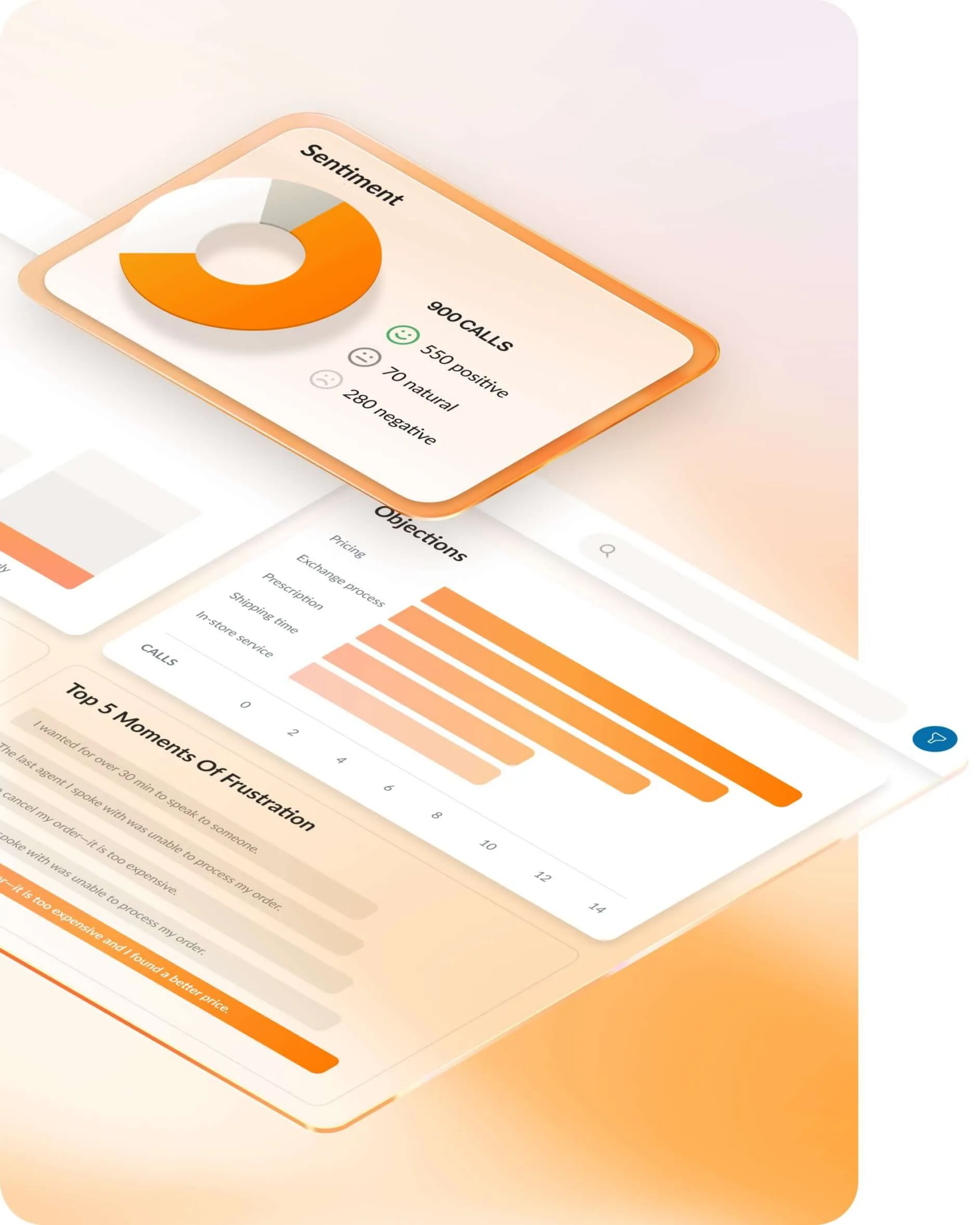
- 100% interaction analysis: RingCX AI Quality Management reviews every conversation instead of a manual sample, so QA and compliance teams work from the full conversation population, not a handful of flagged calls.
- Compliant agent guidance: AVA Agent Assist surfaces checklist and other dynamic guidance in near real time to help agents meet 100% compliance.

Together, they turn raw conversation volume into the documentation and insight a regulated institution has to produce on demand.
Compliance exposure often starts at the front door. RingCentral AI Receptionist (AIR) answers inbound calls and texts around the clock, resolving routine questions from FAQs and documents your bank has approved, and recording and transcribing every interaction.
When a conversation needs a person, AIR hands it to the right agent with context attached, landing inside RingCX where AI Quality Management and AVA Agent Assist take over. The volume that never needed an agent gets cleared on-record, and the rest arrives ready for review.
Bring conversational banking to your institution
Conversational banking is now the customer expectation, and conversational AI is how banks meet it at scale without sacrificing compliance. The institutions pulling ahead treat it as an operating discipline: they connect it to high-volume journeys, wire it into core systems, put risk boundaries in place first, and measure it against containment, resolution, and cost.
The proof is already on the record: national banking assistants, like those from Bank of America and Wells Fargo, are clearing billions of customer interactions. See how a unified contact center platform handles banking conversation volume across every channel with RingCentral’s solutions for financial services.
Conversational AI for banking FAQs
What is conversational banking?
Conversational banking is the practice of letting customers manage their money by talking to the bank in natural language across chat, voice, and messaging channels. It covers the full range of service moments, from balance checks to fraud disputes, and treats the conversation itself as the interface.
How is conversational AI used in banking?
Banks use conversational AI to handle customer inquiries across voice, mobile banking apps, and web chat in real time. It answers account questions, processes payments and transfers, guides loan applications, confirms fraud alerts, and books branch appointments. Because it connects directly to your core banking systems, conversational AI completes transactions and updates records while generating full transcripts and structured data for compliance reporting.
Is conversational AI secure and compliant for banks?
Yes, conversational AI is secure and compliant for banks when you choose a platform built for regulated financial environments. Enterprise-grade systems deliver end-to-end encryption, role-based access controls, and complete audit trails. Certifications like SOC 2 and PCI DSS ensure your platform meets the high standards required for protecting payment data and customer privacy.
What’s the difference between chatbots and conversational AI?
Traditional chatbots follow scripted flows for simple text-based questions. Conversational AI uses natural language processing (NLP) and machine learning to understand intent, handle multi-turn conversations, and execute actions across your banking systems.
While conversational AI chatbots are sometimes simply referred to as “chatbots,” the key distinction is that natural language processing technology allows customers to speak or type naturally instead of following rigid menus.
What’s the difference between conversational banking and mobile banking?
Mobile banking is app-based: customers tap through menus and fill in forms to complete a task themselves. Conversational banking lets customers state what they need in natural language across chat, voice, or messaging, and the system completes the steps, so the conversation replaces the navigation.
Updated Sep 01, 2026